"Sudden and Accidental" vs Gradual Damage — the Line That Decides Your Claim
A pipe that bursts on Tuesday is sudden. The same pipe weeping behind a cabinet since March is gradual. Almost every denied water damage claim turns on which side of that line an adjuster puts you, and the deciding evidence is usually physical, not verbal.
- ✓IICRC-certified technicians
- ✓We document losses in the format adjusters expect
- ✓Colorado Springs and El Paso County
Water damage
What does "sudden and accidental" actually mean?
It is two separate tests, and a claim has to pass both.
Sudden is about time. The event happened abruptly rather than developing over weeks or months. A supply line that lets go, a water heater that splits, a hose that pops off a washing machine — those happen in an instant.
Accidental is about intent and foreseeability. The event was unexpected and unintended from your point of view. You did not cause it deliberately, and you could not reasonably have known it was coming and prevented it.
Most people focus on the first word and lose the claim on the second. A pipe that bursts is unquestionably sudden — but if it burst because you left the house unheated through a February cold snap, a carrier may argue the failure was foreseeable, which goes to whether it was accidental.
The two words together describe an event, not a condition. Insurance is designed to cover events. Deterioration, wear, and slow failure are treated as maintenance — the cost of owning a building — and they are excluded from essentially every standard homeowners policy in the country.
Call (719) 618-9013. Describe what happened and roughly when you found it. We will tell you honestly how it is likely to be read.
📞 Call (719) 618-9013Colorado Springs
Why does this one phrase decide so many claims?
Because water damage is the category where the distinction is hardest to prove and easiest to dispute.
Water damage and freezing is the second most common home insurance claim category in the United States — roughly 24% of all claims — and it carries the highest denial rate of any category, around 10%. The reason recorded is almost always that the damage was judged gradual or maintenance-related.
Compare that to a hail claim. Hail is dated, regional, and corroborated by weather data. Either a storm hit your neighbourhood on 14 June or it did not. There is very little room to argue about when it happened.
Water is different. A leak inside a wall cavity leaves no external record of when it started. The only evidence is the physical condition of the materials — and that evidence is read by an adjuster, after the fact, in a situation where the carrier’s financial interest points one way.
That is not an accusation of bad faith. It is a description of why documentation matters more on a water claim than on almost any other kind.
Water damage
How does an adjuster actually decide which one it was?
By reading the building. Materials record how long they were wet, and an experienced adjuster is looking for a specific list of tells.
Evidence that says "this was recent"
- Clean, sharp water lines on drywall with no discolouration above or below
- Materials still actively wet with high moisture meter readings across a contained area
- No microbial growth, or growth so early it is barely established
- Intact paint and finish at the edge of the damage — no bubbling, flaking or lifting
- Bright, undarkened framing where the wall has been opened
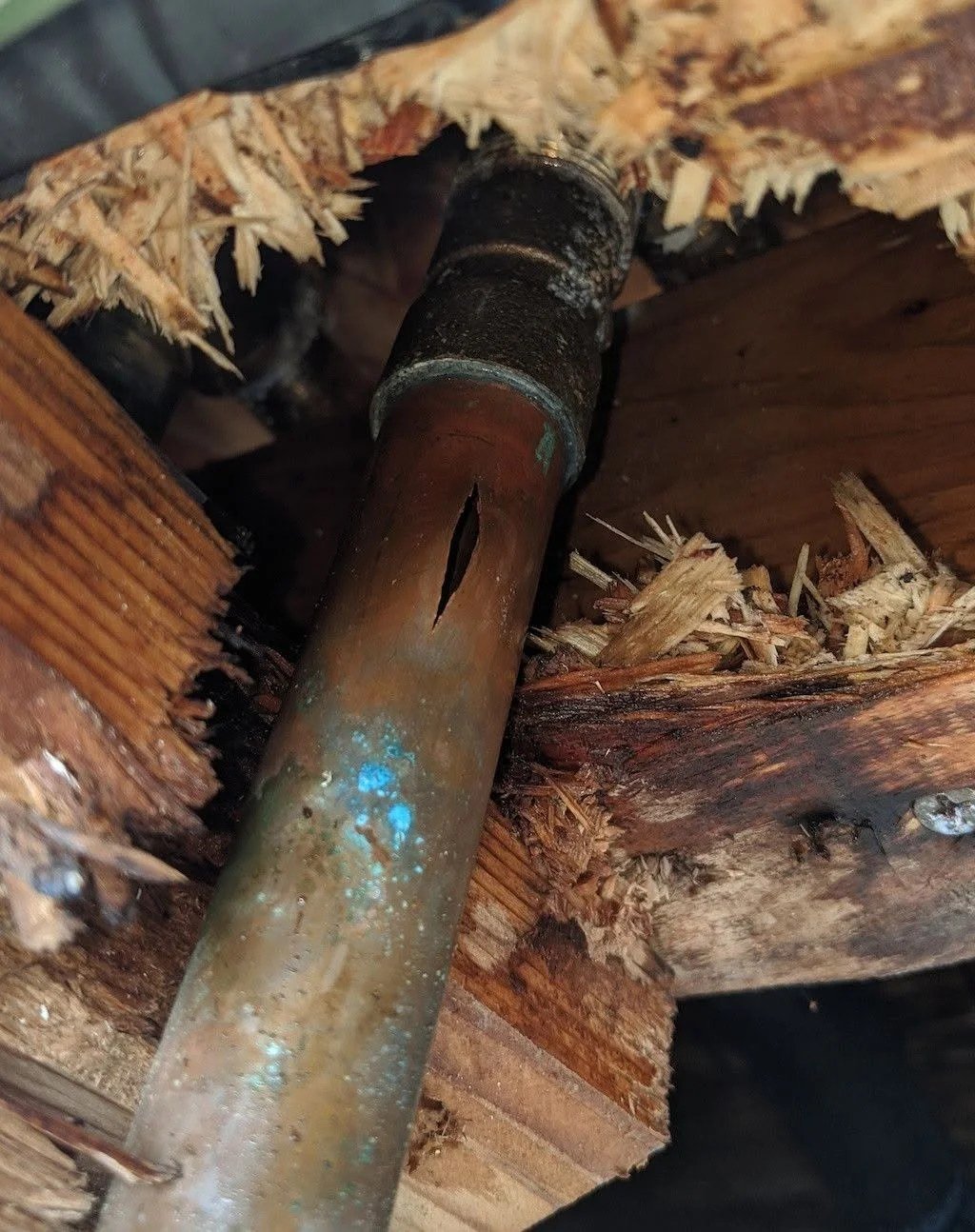
- A failure point with a clean break — a split in the pipe wall, a burst fitting, a hose end that let go
Evidence that says "this has been going on"
- Layered or concentric staining — tide lines at different heights, showing repeated wetting and drying cycles
- Established microbial growth with visible colonies rather than early surface growth
- Mineral deposit or scale at the failure point, which takes months to form
- Corrosion around the leak — green on copper, rust staining on steel
- Darkened, spalled or delaminated framing and subfloor
- Deteriorated adjacent material that got wet, dried, and got wet again
- Cupped or crowned flooring that has already gone through a full moisture cycle
The thing most homeowners do not realise
The adjuster’s assessment happens partly through your mitigation contractor’s documentation. Moisture readings taken on day one, photographs of the failure point before it is repaired, and the recorded scope of what was wet all become part of the record. A restoration company that documents properly is producing evidence in your favour as it works. One that shows up, runs fans and leaves has produced nothing.
That photograph is a good example of the grey zone. The split is sudden. The corrosion around it is not. How that gets characterised depends heavily on how it is documented and argued.
Colorado Springs
What is the "14 days" clause everyone talks about?
It is a specific exclusion found in many policies, and there is a nuance to it that is worth knowing.
The typical wording excludes loss caused by “constant or repeated seepage or leakage of water… over a period of 14 days or more,” or by seepage occurring “over a period of weeks, months or years.”
Three things follow from that, and most homeowners have heard only the first.
1. It is common, but it is not universal. Many non-ISO insurers include this exclusion, and many carriers using ISO forms attach their own exclusionary endorsement. But the standard ISO HO 00 03 homeowners form itself has not contained a repeated-seepage exclusion for around thirty years. Whether it applies to you is a question about your specific policy, not about insurance generally. Read your exclusions section, or ask your agent to point to the clause.
2. Courts have limited how far it reaches. A significant decision held that a policy excluding loss from constant or repeated seepage “over a period of 14 days or more” does not unambiguously exclude loss caused by seepage over 13 days or less. The practical implication: even where a leak ultimately ran for months, damage attributable to the first period may fall outside the exclusion.
3. When the clock starts is itself contested. There is genuine argument about whether the period runs from when the leak began, or from when the homeowner knew or should have known about it. That distinction matters enormously in a hidden leak.
None of this is a promise that your claim will be paid. It is a reason not to accept “it was over 14 days” as the end of a conversation. If a denial rests on this clause, get it in writing with the exact policy language quoted, and have someone read it properly.
Water damage
Which Colorado Springs failures are usually treated as sudden?
These are the ones that tend to be paid, and it helps to know you are on solid ground.
- Frozen pipe bursts. A textbook sudden event. Burst risk climbs sharply below about 20°F with six or more hours of exposure, and the Front Range crossing 32°F several times inside a single day makes this a genuinely regional exposure. Colorado Springs Utilities attributes elevated water main break rates to that same freeze-thaw cycle.
- Water heater rupture. The tank splits, the contents empty onto the floor. Sudden, well documented, and usually straightforward — although scale build-up inside the tank may prompt a maintenance argument.
- Supply line and appliance hose failures. Washer hoses, fridge lines, dishwasher supply. The most common year-round loss in this market and generally sudden.
- Hail-opened roof followed by rain. The storm-created opening is a sudden event, which is what makes the later interior water damage payable. Only if stage one was documented. An undocumented hail event turns the interior claim into “an old roof leaked.”
- Toilet supply or fill valve failure. Sudden, and usually obvious.
- Backflow preventer or sprinkler line burst during spring charge-up or after a failed autumn blowout.
Water on the floor right now?
Tell us where it came from and how long it has been there. We will give you a time, not a window.
24/7 — Colorado Springs and El Paso County
Colorado Springs
Which ones are usually treated as gradual?
These are the harder conversations, and it is better to know before you file than after.
- Cove joint seepage. This is the most common basement water event in Colorado Springs and it is very rarely covered. El Paso County sits on expansive bentonite clay, which swells as it takes on water and presses against the foundation. The Colorado Geological Survey treats expansive soil as a named statewide hazard. Water comes through the seam where the floor slab meets the wall after irrigation or a monsoon storm. Carriers treat it as groundwater or as a maintenance and drainage issue, not as a sudden event.
- Shower pan and tile failures. Water gets past the grout, sits in the pan, and works into the subfloor over months. Almost always characterised as gradual.
- Swamp cooler leaks. Roof-mounted evaporative coolers drip into attics from overflowing pans, worn seals and failed float valves. The damage shows on a ceiling long after the leak started. Seasonal, recurring, and read as maintenance.
- Foundation and window well intrusion. Treated as drainage, grading and maintenance rather than as an insured event.
- Slow supply-line weeping behind cabinetry. The classic denial. By the time the floor buckles, the evidence has been building for months.
- Roof leaks with no storm event attached. An ageing roof that finally lets water through is wear.
Water damage
What about a sudden failure of something that degraded slowly?
This is the genuine grey zone, and it is where most disputes live.
Almost every plumbing failure has a slow phase and a fast phase. A copper line does not corrode through in an afternoon. A polybutylene supply line degrades from the inside over years and then splits in a moment. So is the loss sudden — the split — or gradual — the corrosion?
The general principle carriers apply is that the failure may be sudden even when the deterioration was not, and the resulting water damage may still be covered even where the failed component itself is not. Your policy typically pays to dry the structure and rebuild, but not to replace the pipe.
This matters a great deal in Colorado Springs because of one specific material.
Polybutylene, and why it maps onto whole neighbourhoods here
Polybutylene supply plumbing was installed in American homes from roughly 1978 to 1995. It degrades from the inside out and fails suddenly, often with no external warning. That installation window maps directly onto large parts of the housing stock in 80909, 80915, 80917 and 80920 — East Colorado Springs, Cimarron Hills, Village Seven and Briargate.
If you are in a home of that era with original supply plumbing, a sudden failure is a foreseeable possibility rather than a freak event — and that is exactly the tension a carrier may raise. It cuts both ways: it makes the failure predictable, but it also makes it a known material defect rather than owner neglect.
Colorado Springs
Does "ensuing loss" help me?
Sometimes, and it is worth knowing the concept exists because it is often the strongest argument available on a denied claim.
Many policies contain ensuing-loss language: where an excluded cause of loss leads on to a separate, covered peril, the damage flowing from that second peril may still be covered even though the first cause was not.
Applied to water: if an excluded gradual condition eventually produces a sudden, distinct event, there is at least an argument that the damage from the event is covered. The classic framing is that the excluded cause is the leak, and the ensuing loss is the resulting damage to the structure.
Be careful with this. Ensuing-loss provisions are among the most heavily litigated clauses in property insurance, courts interpret them inconsistently, and the outcome is fact-specific and jurisdiction-specific. This is a concept to raise with a professional, not a clause to quote at an adjuster from a web page.
[LEGAL REVIEW GATE — do not publish this section until a Colorado attorney has approved the wording.]
📞 Call (719) 618-9013Water damage
Why does this hit Colorado Springs homeowners harder than most?
Because the climate here systematically delays discovery — and delayed discovery is exactly what turns a covered event into a denied one.
Low ambient humidity means moisture evaporates readily from exposed surfaces. Drywall faces dry. Carpet feels dry. There is no condensation on the walls and no musty smell in the room, because the moisture is not reaching the room. Behind the drywall, under the pad, inside the stud bay, the assembly is still wet — and because the surface is dry, nothing is drawing that moisture out and nothing is signalling a problem.
In a humid climate the same leak announces itself within days: damp patches, condensation, smell. Here it can run for weeks with no external symptom at all.
Three local situations make it worse:
- Empty homes during PCS season. Colorado Springs has four military installations and PCS peaks May through August. A house closed up mid-move with a slow supply leak has nobody in it to notice. That is the fastest route to a 14-day problem.
- Unheated crawl spaces, common in the older Westside and downtown stock. Nobody goes down there between autumn and spring.
- Post-monsoon crawl and basement moisture. Water arrives in late July; discovery often waits until something smells in October.
Why this matters for your claim: if you are denied on the grounds that you should have known, the fact that the local climate suppresses the ordinary warning signs is a relevant, arguable point. It is not a guaranteed answer. It is a reason not to accept “you should have caught this” without pushing back.
Colorado Springs
How do I document a claim so it survives this test?
The documentation that decides a water claim is created in the first 48 hours, usually before anyone has thought about the claim at all.
- 1Photograph the failure point before it is repaired. This is the single most valuable image you will take, and it is the one most often missed because a plumber fixes the pipe and takes the old section away. Ask for it. Keep it.
- 2Photograph the damage in place, before anything moves. Wide shots of each affected room, then close-ups. Do not tidy first.
- 3Video walkthrough with narration. Say the date out loud and describe what you are seeing. Timestamped video is harder to argue with than stills.
- 4Get moisture readings on day one and keep the log. Any competent restoration contractor produces these. Ask for a copy rather than assuming you will get one.
- 5Write down when you first noticed anything at all — a smell, a sound, a mark — and be honest about it. A carrier discovering an inconsistency later does more damage than an early disclosure.
- 6Keep the removed material where practical, or photograph it clearly before disposal.
- 7Report promptly. A gap between discovery and reporting is one of the most damaging facts in a water claim, and it is entirely within your control.
Call (719) 618-9013. We produce the moisture log and the photographic record as part of the mitigation, and you get a copy.
📞 Call (719) 618-9013Water damage
My claim was denied as gradual. What now?
A denial is a position, not a verdict. Work through it in order.
- 1Get the denial in writing, with the exact policy language quoted. Not a phone call, not a summary — the clause. If the denial rests on a seepage exclusion, you need the wording and the time period it specifies.
- 2Check whether that exclusion is actually in your policy. As covered above, the 14-day clause is common but not universal.
- 3Assemble the counter-evidence. Day-one moisture readings, the failure-point photograph, the repair invoice with its date, and any evidence about when the condition could first reasonably have been noticed.
- 4Request a re-inspection and supply that documentation. A surprising number of denials are reversed at this stage without anything adversarial happening.
- 5File a complaint with the Colorado Division of Insurance if the carrier will not engage. It is free and it creates a record.
- 6Then consider counsel. Colorado provides a statutory remedy for unreasonable delay or denial of first-party benefits under C.R.S. §§ 10-3-1115 and 10-3-1116, which allows recovery of two times the covered benefit plus reasonable attorney fees and costs.
Colorado Springs
When is it genuinely gradual, and you should accept it?
Sometimes the carrier is right, and knowing that saves you months.
If a shower pan has been leaking into the subfloor for two years, if a basement takes on water at the cove joint every spring and has done for a decade, if a roof has reached the end of its life — those are maintenance costs. They are not insured events, and no amount of argument changes that.
Fighting an unwinnable denial costs time, legal fees and a great deal of stress, and it delays the repair while the damage continues to grow.
Signs the denial is probably correct:
- You knew about the condition and did not repair it
- The same thing has happened before in the same place
- The evidence shows years rather than weeks of wetting
- There was no discrete failure event at all
- The cause is drainage, grading or ordinary wear
In that situation the useful conversation is about scope and cost, not coverage. We will tell you which conversation you are in.
Water damage
What happens when you call
- 1You describe what failed and when you found it. Those two facts, together, tell us most of what we need.
- 2We give you an honest read on how it is likely to be characterised — including when we think a claim is not worth opening.
- 3If we mitigate, we document as we go. Moisture log, failure-point photographs, scope. You get a copy whether or not you file.
Call (719) 618-9013 — Colorado Springs and El Paso County, 24/7.
📞 Call (719) 618-9013Frequently asked
Questions people actually ask
How long is too long for a water leak?
Can they deny it just because the pipe was old?
What if I genuinely could not have known?
Does a home warranty cover gradual damage?
Should I tell the adjuster I noticed a smell months ago?
Does filing and being denied still count against me?
Call Dry Standard Restoration
IICRC-certified. We meter before we quote, and you get the readings.
24/7 — Colorado Springs and El Paso County