Water Mitigation in Colorado Springs
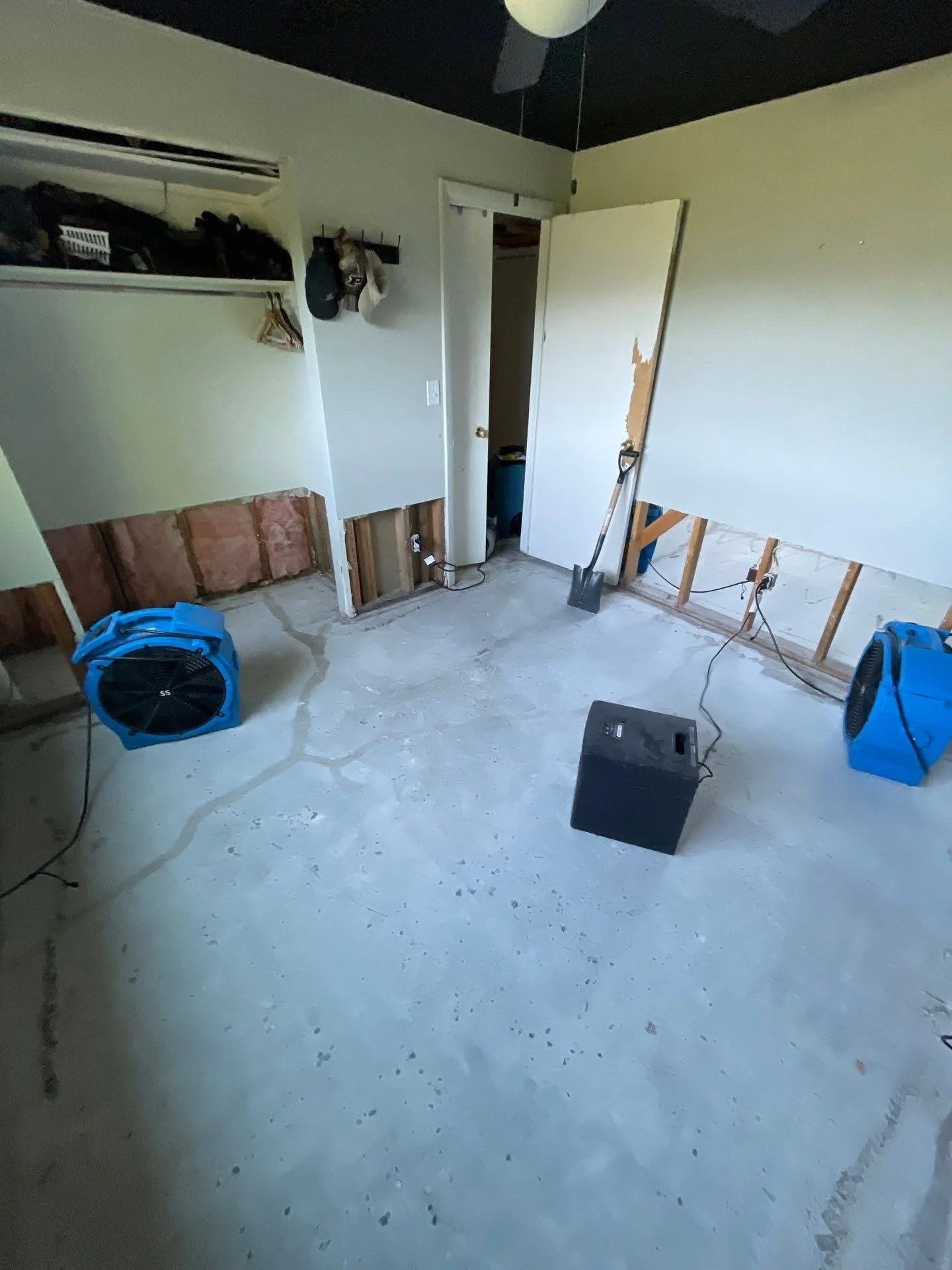
Water mitigation is the emergency phase of a water loss — stopping the damage from getting worse. Extraction, removing unsalvageable material, and drying the structure to a documented standard. It is not the repair. Putting the building back is a separate phase, usually a separate quote, and often a separate line on your claim.
- ✓IICRC-certified technicians
- ✓Work to the IICRC S500 standard
- ✓Documented moisture logs
- ✓Colorado Springs and El Paso County
Water damage
What is the difference between water mitigation and water restoration?
Mitigation stops the loss getting worse. Restoration puts the building back. They are different work, done at different times, priced in completely different ways.
| Mitigation | Restoration / reconstruction | |
|---|---|---|
| Goal | Prevent further damage | Return the building to pre-loss condition |
| Timing | Hours to days after the loss | After the structure is verified dry |
| Typical work | Extraction, removal of unsalvageable material, drying, cleaning | Drywall, texture, paint, flooring, trim, cabinetry |
| Priced by | Equipment on site and days deployed | Materials and labour, like any construction job |
| Ends when | Moisture readings hit the dry standard | The room looks like it did before |
The practical consequence: you may get two quotes for one event and think you are being double-billed. You are not — you are seeing two phases. Carriers frequently handle them as separate scopes with separate approvals, and the mitigation invoice often arrives while the reconstruction scope is still being negotiated.
This is the single most common source of water damage invoice confusion, and almost nobody explains it before the paperwork lands.
Colorado Springs
What does water mitigation actually include?
Five things. If a mitigation quote is missing one of them, ask why.
Stopping the source. Or confirming it has already stopped. On a Colorado Springs basement with no plumbing failure upstream, this is frequently where the cove joint gets identified — and where a homeowner learns there is no leak to find.
Extraction. Bulk water first, then truck-mount or portable extraction, then weighted extraction on carpet. Every gallon pulled out mechanically is a gallon the dehumidifiers do not have to remove from the air over the following days.
Removal of unsalvageable material. Carpet pad, batt insulation, particleboard, and drywall where the water reached it — typically a flood cut above the waterline so the cavity can dry. Framing lumber is almost always saved.
Structural drying. Air movers plus dehumidification, sized to the class of loss, with readings taken daily and equipment repositioned as areas reach target.
Cleaning and antimicrobial treatment. HEPA vacuuming, damp wiping, and antimicrobial where the water category or elapsed time warrants it — as the last step, not the first.
Not included: drywall replacement, texture, paint, flooring, trim, cabinetry. That is reconstruction.
Water damage
How is water mitigation billed?
Largely by equipment and by day, and understanding that structure explains almost every mitigation invoice question.
The main components are typically:
- Emergency service and set-up — the initial visit, safety and source work, metering
- Extraction — usually by area or by volume
- Equipment — per unit, per day. Air movers and dehumidifiers are counted separately and each day they run is a day billed
- Labour — technician hours for placement, daily monitoring visits and takedown
- Materials disposal — removal and haul-away of what came out
- Antimicrobial — where applied, by area
Most restoration companies in this market price mitigation using Xactimate, the estimating platform carriers also use. That is why two mitigation invoices for similar losses can look structurally alike while differing significantly in total — the line items are standardised, the quantities are not.
What moves the number most: the number of equipment days. That is driven by how much material is wet, how dense it is, and how quickly extraction happened. It is not arbitrary, and it is checkable against the moisture log.
Colorado Springs
Does insurance treat mitigation differently from repairs?
Often, yes — and in a way that generally works in your favour.
Most policies impose a duty on you to take reasonable steps to prevent further damage after a loss. Mitigation is the fulfilment of that duty. That is why carriers routinely authorise mitigation to begin before an adjuster has inspected, and why mitigation invoices are frequently approved faster and with less argument than reconstruction scopes.
Three things follow from this:
You do not need to wait for an adjuster to start. Waiting while water sits does not protect your claim. The additional damage that accrues during the wait may be attributed to your delay rather than to the original event.
Mitigation and reconstruction may be approved separately. Mitigation can be settled and paid while the rebuild scope is still under discussion. Two payments for one event is normal, not an error.
Documentation is what makes mitigation defensible. Moisture readings, photographs, equipment logs, and a scope written in the format adjusters expect. A contractor who cannot produce a moisture log cannot justify the equipment days, and that is where mitigation invoices get reduced.
Coverage depends on your specific policy. We are a restoration contractor, not licensed insurance advisers.
Water on the floor right now?
Tell us where it came from and how long it has been there. We will give you a time, not a window.
24/7 — Colorado Springs and El Paso County
Water damage
When does mitigation end?
When moisture readings on affected material match unaffected material of the same type in the same building. That comparison is the dry standard, and it is the only defensible definition of finished.
It matters because “dry” is not a fixed number. Dry for framing lumber is not dry for gypsum board, and dry for oak flooring in January is not dry for the same floor in July. A reading of 14% means one thing on a subfloor and something else on a stud.
In Colorado Springs this is where jobs go wrong. Low ambient humidity pulls moisture off exposed surfaces quickly, so drywall faces, carpet and subfloor tops feel dry within a day or two while the assembly behind them is still holding water. There is no condensation and usually no musty smell, because the moisture is not reaching the room.
How a wall feels is the least reliable indicator available in this climate. Equipment coming out because the room feels dry — rather than because it meters dry — is how a mitigation job that appeared cheap becomes a reconstruction job that has to be done twice.
Ask for the readings. Not a verbal assurance that things were checked.
Colorado Springs
Why does mitigation take three to five days?
Because bound water leaves materials at a rate set by physics, not by scheduling.
Extraction removes free water — what you can see and reach — usually in a few hours. What is left is bound into the materials, and it comes out through evaporation. Air movers break the boundary layer of saturated air sitting against wet surfaces so evaporation can continue; dehumidifiers remove the moisture the air movers put into the air. Both have to run for that to work.
Dense materials take longer. Plaster over lath in the pre-1940 Westside and Old North End stock, tile over a mud bed, hardwood, and engineered flooring all release water slowly. A 1970s ranch with carpet over plywood dries far faster than a century home with plaster walls.
Cold spaces take longer. Evaporation slows as temperature drops, which is why unheated crawl spaces and winter losses in garages and north-facing exterior walls run long. Desiccant dehumidifiers keep working in conditions where refrigerant machines lose efficiency, which is often the right call here between November and March.
Altitude changes the arithmetic. At 6,035 feet, reduced air density means dehumidifiers do not deliver their sea-level rated capacity. Equipment selection is a technical decision, not a formality — and a company that sizes off the nameplate without derating will under-equip the job and run longer than it needed to.
The trade is real: a few noisy days against a much longer, more expensive job.
Water damage
Can I do the mitigation myself and only pay for the repairs?
Sometimes — and here is the honest boundary.
You can very likely handle it yourself if all of these are true:
- Under roughly 10 square feet
- Clean water from a supply line — not a drain line, not from outdoors
- Caught within about 24 hours
- On a hard surface, or on carpet you are willing to lift
- Nothing near the electrical panel, the furnace or the water heater
Pull the carpet back, get the pad out, run a fan across the area at a low angle rather than pointed straight down, put a dehumidifier in the room with the door closed, and check it in 48 hours.
Where DIY mitigation fails, and it fails in the same three places every time:
- 1Rental equipment is undersized. A consumer dehumidifier removes a fraction of what a low-grain refrigerant unit does, and it is rated at sea level.
- 2You cannot see inside the assembly. Without meters you are guessing about the wall cavity, the subfloor and under the cabinet run — and in dry Colorado air, the surface will feel dry long before the assembly is.
- 3There is no documentation. If you later need the claim, or you sell the house, or growth appears, you have nothing showing what was done and to what standard.
A shop vac will not get water out of carpet pad, pull it back out of drywall, or tell you whether the subfloor underneath is still wet. Those three things decide whether a small job stays small.
Call if it still feels damp after two days, a musty smell develops, it reached drywall or insulation, it went under a cabinet run, or it was anything other than clean water.
Colorado Springs
What makes mitigation different in Colorado Springs?
Four local conditions change how mitigation is scoped, equipped and timed here.
Most basement water has no upstream source. El Paso County sits on expansive bentonite clay, which swells as it takes on water and presses against foundations. The Colorado Geological Survey treats expansive soil as a named statewide hazard. After heavy irrigation or a monsoon storm, that pressure pushes water through the cove joint — the seam where the basement floor slab meets the foundation wall. Water appears along the perimeter and spreads inward. Mitigation still applies; source repair does not, because the source is outside the building.
Freeze-thaw drives winter volume. The Front Range can cross 32°F several times inside 24 hours, and Colorado Springs Utilities attributes elevated water main break rates directly to that cycle. Burst risk climbs sharply below about 20°F with six or more hours of exposure. Winter mitigation runs longer because cold spaces evaporate slowly.
Monsoon and burn scars compress the calendar. The North American monsoon concentrates flash flood risk from roughly mid-July to mid-September, and flooding off the 2012 Waldo Canyon scar — 18,247 acres across four sub-watersheds — can begin within about 15 minutes of heavy rain starting. During those events every mitigation crew in the region is at capacity at once.
Dry air cuts both ways. Low ambient humidity is a genuine advantage when drying — more capacity in the air to take moisture up, so with correct airflow a loss here can dry in fewer equipment days than the same loss in a humid climate. It is also exactly why losses are found late, and why metering rather than touching is not optional here.
Water damage
Which areas do you cover?
Colorado Springs and El Paso County — downtown and Shooks Run (80903), Old North End (80907), Westside and Old Colorado City (80904, 80905), Broadmoor and Skyway (80902, 80906), the southeast (80910, 80916), east Colorado Springs (80909, 80915, 80917), Austin Bluffs and Vista Grande (80918), Rockrimmon and Mountain Shadows (80919), Briargate and Northgate (80920, 80921), the Powers corridor (80922, 80923, 80924, 80938, 80939, 80951), Peterson Space Force Base (80914), Fort Carson (80913), Security-Widefield and Fountain (80911, 80925, 80926), Black Forest and Falcon (80908), and Banning Lewis Ranch and the far east (80927, 80928, 80929, 80930).
Colorado Springs
How to check a mitigation company is doing it properly
Five things, checkable on us or on anyone else.
- Ask for daily moisture readings. This is the single best test. A company that cannot produce a moisture log is not measuring, and cannot justify its equipment days.
- Ask which IICRC certifications the technicians hold. WRT for water restoration, ASD for structural drying, AMRT for microbial. Ask about the technician, not the logo.
- Ask what the dry standard is for your job and what material it is being compared against. A company that answers with a single number and no baseline is not using one.
- Ask whether the quote is mitigation only. Then ask what the reconstruction scope looks like, so you are not surprised twice.
- Ask who is doing the work. After a hail or flood event this market fills with out-of-area crews who will not be reachable when something needs revisiting.
Contractor licensing for permitted work runs through the Pikes Peak Regional Building Department, which covers all of El Paso County. And worth knowing for any mould component: Colorado has no state licence or registration for mold remediators, and CDPHE does not regulate mold. There is no state credential to check, which makes IICRC certification and documented process more important here, not less.
Water damage
What happens when you call
- 1Three or four questions. Where the water came from, how long it has been there, what it has reached, whether it is still coming in.
- 2A time, not a window.
- 3We meter before we quote, and the mitigation scope is priced from the readings. You get the readings whether or not we do the reconstruction.
Call (719) 618-9013 — Colorado Springs and El Paso County, 24/7.
📞 Call (719) 618-9013Frequently asked
Questions people actually ask
Is water mitigation the same as water damage restoration?
How long does water mitigation take?
Does homeowners insurance pay for water mitigation?
Can mitigation start before the adjuster comes out?
What is a dry standard?
Why is the equipment charged per day?
Call Dry Standard Restoration
IICRC-certified. We meter before we quote, and you get the readings.
24/7 — Colorado Springs and El Paso County