
What to Ask Your Insurance Adjuster About Water Damage
Ask four things above everything else: what is in the scope, whether it is being paid at actual cash value or replacement cost, how much depreciation is being held back and what you must do to get it, and which deductible applies. Those four answers determine most of what you will actually receive.
Call (719) 618-9013 — 24/7, someone answers.
- IICRC-certified technicians
- We document losses in the format adjusters expect
- Colorado Springs and El Paso County
Insurance
What actually happens during an adjuster visit?
Usually less than people expect, and faster.
The adjuster walks the property, photographs the damage, takes measurements, and builds a scope of loss — a room-by-room list of what was damaged and what it will take to repair. That scope becomes an estimate, generally produced in Xactimate, the software most carriers use, which prices line items against a regional price list updated periodically.
Most residential water damage inspections take between thirty minutes and a couple of hours. The adjuster is not usually a builder, and on a water loss they may not open walls. What they can see and what you can show them is largely what gets scoped.
That is the single most important thing to understand. The scope is built from observation. If a wet area is not visible, not documented and not raised on the day, there is a good chance it will not be in the estimate — and adding it later means a supplement, which takes time.
Call (719) 618-9013. If we have already mitigated your loss, you will have moisture readings and photographs to hand the adjuster. That is the difference between arguing and showing.
Call (719) 618-9013Response
What should I have ready before they arrive?
Everything below fits in one folder and materially changes the outcome.
- Photographs and video from before anything moved. Wide shots of each room, then close-ups, then the failure point.
- A photograph of the actual failure — the split pipe, the failed supply line, the cracked fitting. Ask your plumber for the removed section or a photo of it. This is the most valuable image in the whole file and the one most often lost.
- Moisture readings from day one, with the log. Any competent restoration contractor produces these. Ask for a copy.
- The mitigation scope and invoice, if work has started.
- A written inventory of damaged contents, with approximate age and original cost where you know it.
- Your policy declarations page — so you can check the deductibles yourself rather than being told.
- A list of what you have already spent, with receipts.
- A written list of questions. The ones below.
Walk the property with the adjuster rather than waiting in another room. Point at things. Ask them to photograph what you point at.
Colorado Springs
The questions to ask about scope
These decide what is included at all.
- "Can you walk me through the scope room by room before you leave?" Catching an omission on the day is trivial. Catching it in three weeks is a supplement.
- "Which rooms and materials are you including, and which are you excluding?" Ask for the reason on anything excluded.
- "Are you scoping to the moisture readings, or to what is visible?" In this climate that distinction matters more than almost anywhere — see the Colorado Springs section below.
- "Is the drying equipment and the number of days included?" Mitigation is billed by equipment and by day. It is a common gap.
- "Have you included the tear-out required to reach the damage, not just the damage itself?" Access is a real cost.
- "What about materials that were not damaged but now will not match?" Continuous flooring, a run of cabinetry, a tiled wall. Policies vary on this and it is worth asking directly.
- "Is there any code upgrade required by the repair, and is that covered?" Ordinance and law coverage is a separate limit and it is frequently overlooked.
- "Does this loss trigger additional living expenses?" If the home is uninhabitable.
Colorado Springs
The questions to ask about money
This is where most homeowners lose the most, usually by not knowing what to ask.
- "Is this being settled at actual cash value or replacement cost value?"
- "How much depreciation are you holding back, and is it recoverable?"
- "What exactly do I have to do to recover it, and by when?"
- "Which deductible applies — the standard one, or a separate wind and hail deductible?"
- "Is general contractor overhead and profit included in this estimate?"
- "What price list version is this Xactimate estimate using?"
- "Is there a mold sublimit, and does this loss touch it?"
- "If the mitigation invoice exceeds your estimate, how is that resolved?"
The next two sections explain the two that cost people real money.
Coverage
What is recoverable depreciation, and how do I actually get it?
This is the most commonly misunderstood mechanic in property claims, and it is worth a few minutes.
Replacement cost value (RCV) is what it costs to replace something new. Actual cash value (ACV) is RCV minus depreciation — what the used item was worth.
If your policy settles at replacement cost, the carrier does not usually pay RCV up front. It pays ACV first, holding back the depreciation. That held-back amount is recoverable depreciation, and you get it as a second payment — often called the second check — after the repairs are actually completed and you have submitted the invoices.
Three consequences follow, and the third is where people lose money.
- 1
The first cheque will look too small
That is expected, not an error. It is the ACV payment.
- 2
If you do not complete the repairs, you do not get the holdback
The depreciation is only recoverable against work actually done and documented.
- 3
There is a deadline
Most policies impose a time limit for completing repairs and claiming the holdback — commonly in the range of 180 days to a year from the date of loss. Miss it and the money is simply gone.
So the questions to ask are specific: how much is being held back, what documentation do you need from me to release it, and what is the deadline. Write the answers down.
If the repair is going to run past the deadline for a legitimate reason — contractor availability, a supplement in dispute, a long lead-time material — ask in writing for an extension before the date passes rather than after.
Colorado Springs
What is overhead and profit, and am I entitled to it?
When a repair needs multiple trades coordinated — say a plumber, a drywaller, a flooring installer and a painter — a general contractor typically manages that work and charges overhead and profit on top of the subcontractors' costs, conventionally shorthanded as O&P.
Whether a carrier includes O&P in an estimate is one of the most common disputes in property claims. The majority position across the industry is that O&P should be included in both replacement cost and actual cash value calculations whenever the use of a general contractor is reasonably likely — which, on a multi-trade water loss, it usually is.
A rough working test many people use: if the repair involves three or more trades, a general contractor is reasonably likely, and O&P should be in the estimate.
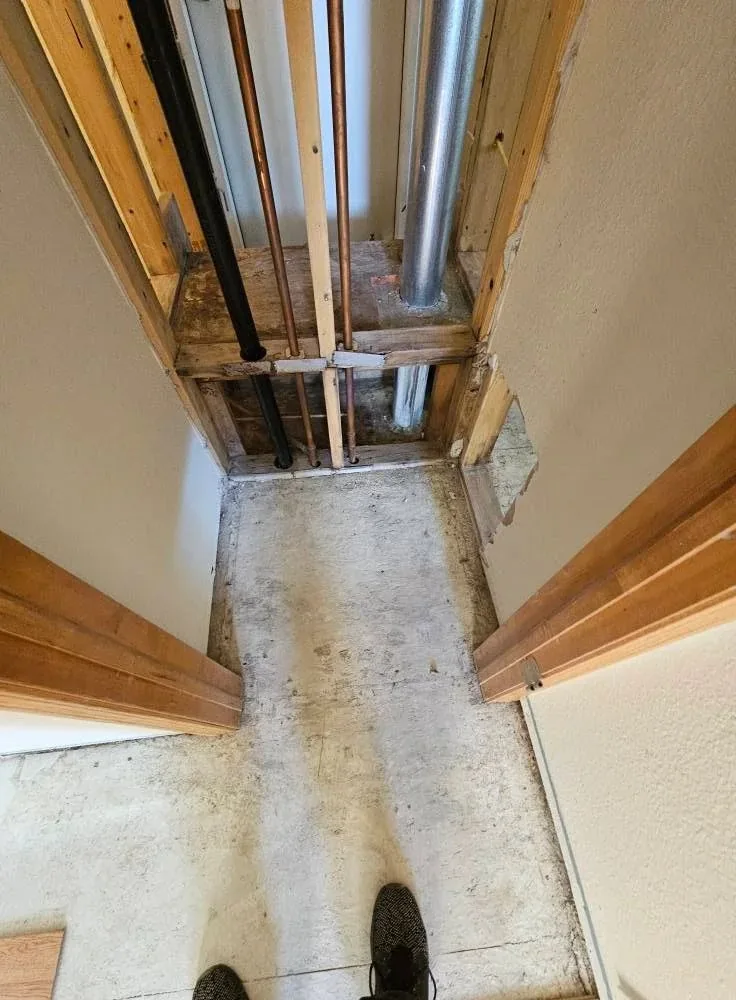
Ask directly: "Is general contractor overhead and profit included?" If it is not, and the job clearly needs a GC, ask why not and ask for the answer in writing. This is a legitimate, well-established question and a reasonable adjuster will not be surprised by it.
Water on the floor right now?
Tell us where it came from and how long it has been there. We will give you a time, not a window.
Call (719) 618-9013Insurance
Which deductible applies — and why this matters more in Colorado
Ask specifically, because many Colorado policies now carry two different deductibles.
A standard "all other perils" deductible applies to most losses. A separate wind and hail deductible — frequently a percentage of the dwelling limit rather than a flat figure — applies to storm damage. On a higher-value home, a percentage deductible can be several times the flat one.
This matters on water damage claims because of the two-stage loss. If hail opened your roof and rain then came in, the claim may be characterised as wind and hail, which brings the larger deductible with it.
Read your declarations page before the adjuster arrives and ask which deductible they are applying and why. If the characterisation is arguable, that is a conversation worth having on the day.
For context on why Colorado policies are structured this way: hail accounts for 26% to 54% of a Colorado homeowner's premium depending on county, and roughly 50% along the Front Range, according to the Colorado Division of Insurance's February 2026 analysis of data covering about 80% of the market across 11 counties.
The process
The questions to ask about process and timeline
- "What is my claim number and who is my point of contact from here?" Adjusters change, especially after a storm event.
- "When will I receive the estimate, and in what format?" Ask for the full Xactimate PDF with line items, not a summary page.
- "What is the timeline for the first payment?"
- "Is the mortgage company going to be named on the cheque?" On larger losses it usually is, which adds a step and a delay most people do not anticipate.
- "What do you need from my contractor, and in what format?"
- "If I disagree with the scope, what is the process?"
- "Is there anything in this claim you think may be contested later?" A straightforward question that occasionally gets a very useful answer.
Colorado Springs
What should I not say?
Be honest and be accurate. But understand that a few habits of speech genuinely damage claims.
Do not guess at dates
"It's probably been leaking a while" is a sentence that costs claims. If you do not know when it started, say you do not know.
Do not minimise
People downplay damage out of politeness. The scope is built from what you show and say.
Do not speculate about cause
If you are not certain what failed, do not offer a theory. "I found water here on Tuesday morning" is a fact. "I think the pipe has been going for months" is a guess that becomes evidence.
Do not admit to deferred maintenance you are not sure about
If you genuinely knew about a problem and did not act, be honest — carriers investigate and a discovered inconsistency is far more damaging. But do not volunteer an assumption.
Do not sign anything you have not read
particularly anything described as a release or a final settlement.
Do not agree a number on the spot
"I'd like to review the estimate before I respond" is a complete and reasonable sentence.
Response
How do I read the estimate when it arrives?
Ask for the full line-item document. A summary page tells you nothing you can check.
What to look for:
- Room-by-room line items with quantities. Square footage of drywall, linear feet of baseboard, number of equipment days.
- Whether the quantities match reality. Measure a couple of rooms yourself. Errors here are common and honest.
- Mitigation and reconstruction as separate sections. Drying is one job; rebuilding is another. Conflating them hides gaps.
- The depreciation column, line by line, and whether it is marked recoverable.
- Whether O&P appears as a line.
- The price list date. Xactimate price lists update periodically; an old list on a current job under-prices materials.
- Anything scoped as "repair" that realistically needs "replace."
If something is missing, that becomes a supplement — a request to add scope, supported by documentation. Supplements are routine and expected. They are not a fight.
Colorado Springs
What if I disagree with the scope?
Work through it in order, and keep it in writing.
- 1
Ask for a re-inspection
and be specific about what you want looked at again.
- 2
Supply the evidence
your contractor's scope, moisture readings, photographs of what was found once material came out.
- 3
Have your contractor speak to the adjuster directly
Two people using the same vocabulary resolve most scope disputes without any adversarial step.
- 4
Submit a written supplement
with the documentation attached.
- 5
Escalate within the carrier
ask for a supervisor or a desk adjuster review.
- 6
File a complaint with the Colorado Division of Insurance
if the carrier stops engaging. It is free and it creates a record.
- 7
Then consider a public adjuster or counsel
Colorado also provides a statutory remedy for unreasonable delay or denial of first-party benefits under C.R.S. §§ 10-3-1115 and 10-3-1116, allowing recovery of two times the covered benefit plus reasonable attorney fees and costs.
Insurance
Staff adjuster, independent adjuster, public adjuster — who is who?
Worth knowing who is standing in your house.
Staff adjuster
employed by your insurance carrier. Works for them.
Independent adjuster
contracted by the carrier, often surged in after a large storm event. Also works for them, and may be handling a very high volume.
Public adjuster
hired and paid by you, typically on a percentage of the settlement. Licensed in Colorado. Works for you.
Desk adjuster
handles the file remotely, sometimes without ever visiting.
None of that is sinister; it is just the structure. But it is useful to know that the person walking your property may be carrying two hundred files after a hail event, which is a reason to be organised and specific rather than to assume everything will be caught.
We do not perform public adjusting and do not receive anything for mentioning it. If a claim is large and going badly, it is an option worth knowing exists.
Insurance
What will an adjuster look for in a Colorado Springs home specifically?
Four things, and knowing them in advance is genuinely useful.
1. Whether the water was groundwater
If it appeared along the edges of a basement floor, expect questions about whether it came through the cove joint. Expansive bentonite clay swells after irrigation or a monsoon storm and presses water through that seam — and groundwater is excluded under a standard homeowners policy. Be ready to show where the water actually originated if it was a plumbing failure.
2. Evidence the damage was gradual
Layered staining, mineral scale at the failure point, corrosion, established growth, cupped flooring that has already been through a moisture cycle. This is the single most common denial ground on water claims.
3. The condition and history of your roof
if hail is anywhere in the picture. An undocumented hail event turns an interior water claim into "an old roof leaked."
4. Whether the basement is finished, and to what standard
It drives a large part of the scope and it is worth walking them through it rather than letting it be estimated from a doorway.
The local point almost nobody raises
In this climate, an adjuster who checks by touch will under-scope the drying.
Colorado Springs air is dry. Moisture evaporates readily from exposed surfaces, so drywall faces, carpet and subfloor tops feel dry within a day or two while the assembly behind them is still holding water. There is no condensation and often no smell, because the moisture is not reaching the room.
An inspection based on how a wall feels will therefore understate how much material is wet — and the estimate will follow the inspection.
So ask directly: "Are you scoping to meter readings or to what is visible?" Then hand over the moisture log. A documented reading against unaffected material of the same type is not an opinion, and it is very hard to scope around.
The process
What happens when you call
- 1
We walk the loss with you before the adjuster arrives
and tell you what to point at.
- 2
You get the moisture log and the photographs
in a format an adjuster can use, whether or not we do the reconstruction.
- 3
We will speak to your adjuster directly
if you want us to. Most scope disagreements resolve in one conversation between two people using the same vocabulary.
Call (719) 618-9013 — Colorado Springs and El Paso County, 24/7.
Call (719) 618-9013FAQ
Frequently asked questions
Should I be present for the adjuster's inspection?
Yes, and walk the property with them rather than waiting elsewhere. The scope is built largely from what is visible and what you raise on the day. Point things out and ask them to photograph what you point at.
Can my contractor meet the adjuster?
Yes, and it usually helps. Two people using the same vocabulary resolve most scope questions on the spot. It is common, expected, and not adversarial.
How long does the adjuster have to respond?
Timelines depend on your policy and the circumstances. Colorado law does provide a remedy where an insurer unreasonably delays or denies payment of first-party benefits under C.R.S. §§ 10-3-1115 and 10-3-1116. If communication has stopped, put a request in writing and note the date.
Why is my first cheque so much smaller than the estimate?
Because it is almost certainly the actual cash value payment, with depreciation held back. If your policy is replacement cost, you recover that holdback as a second payment once repairs are complete and invoices submitted — subject to a deadline, so ask what it is.
Do I have to use the contractor my insurer recommends?
No. Preferred vendor programmes exist for the carrier's convenience and can be genuinely useful, but you choose who works on your home.
What if I find more damage after the adjuster has been?
That is a supplement, and it is routine — particularly on water losses, where the full extent is often only visible once material comes out. Document what was found, when and by whom, and submit it through your adjuster.
Call (719) 618-9013 — 24/7, Colorado Springs and El Paso County.
Call (719) 618-9013This resource has been compiled and reviewed under the ANSI/IICRC S500 Standard and Reference Guide for Professional Water Damage Restoration, Colorado Department of Regulatory Agencies (DORA) insurance requirements, and El Paso County regional building codes. For on-site moisture assessments in Colorado Springs, call (719) 618-9013.