Mold Remediation in Colorado Springs
Real mold remediation means finding and fixing the moisture source, sealing the work area, removing what cannot be cleaned, and proving the job is finished — not spraying and painting over it.
- ✓IICRC-certified technicians
- ✓Work to the IICRC S520 standard
- ✓Licensed and insured
- ✓Colorado Springs and El Paso County
Water damage
Does Colorado license mold remediation companies?
No. Colorado has no state licensing or registration programme for mold inspectors or remediators, and the Colorado Department of Public Health and Environment states that it does not regulate mold. A bill in 2025 would have created a registration system requiring third-party certification and evidence of financial responsibility. It did not pass.
That means anyone in this state can print “mold remediation” on a van tomorrow. There is no board to check, no state number to look up, and no licence to lose. Some municipalities require a local business licence, and structural work still needs permits through the Pikes Peak Regional Building Department — but the mold work itself sits outside all of that.
So the vetting falls to you. Here is what to actually check.
What to ask before you hire anyone for mold work in Colorado
- IICRC certification, and which one. AMRT (Applied Microbial Remediation Technician) is the mold credential. WRT and ASD are water damage and drying. Ask for the certification number and the technician’s name, not just a logo on the website.
- Who is doing the testing. If the company that tests is the company that remediates and then re-tests its own work, that is a conflict. Independent post-remediation verification is worth the extra cost.
- A written scope before work starts. Square footage, what comes out, what containment is used, and what the clearance criteria are.
- Proof of liability insurance that covers mold. Many general policies exclude it. Ask to see the certificate.
- Whether they will tell you it is small enough to do yourself. A company that never says that is selling, not assessing.
Call (719) 618-9013. We will tell you on the phone whether what you are describing needs a remediation crew or a Saturday afternoon.
📞 Call (719) 618-9013Colorado Springs
How do I know if this is mold or just a stain?
Mold is usually raised, often fuzzy or speckled rather than flat, and it tends to spread in irregular patches rather than in a clean line. Water staining is flat, follows gravity or a seam, and often has a defined tide line. If you can smell it — that damp, earthy, slightly sweet smell — it is mold, whether you can see it or not.
The reliable test is not visual. Growth needs sustained moisture, so the real question is whether the material is still wet. A moisture meter answers that in ten seconds. A stain on a ceiling that meters dry is old damage from a leak that has already been fixed. The same stain metering wet is an active problem.
Where it usually shows up first in Colorado Springs homes: behind baseboards at the wall-floor joint, under sheet vinyl and laminate, along the cove joint in basements, in unheated crawl spaces on the Westside, behind shower surrounds, and in attics under roof-mounted evaporative coolers.
Water damage
Why does mold get found so late in Colorado Springs?
Because the air here is dry, and dry air hides wet buildings.
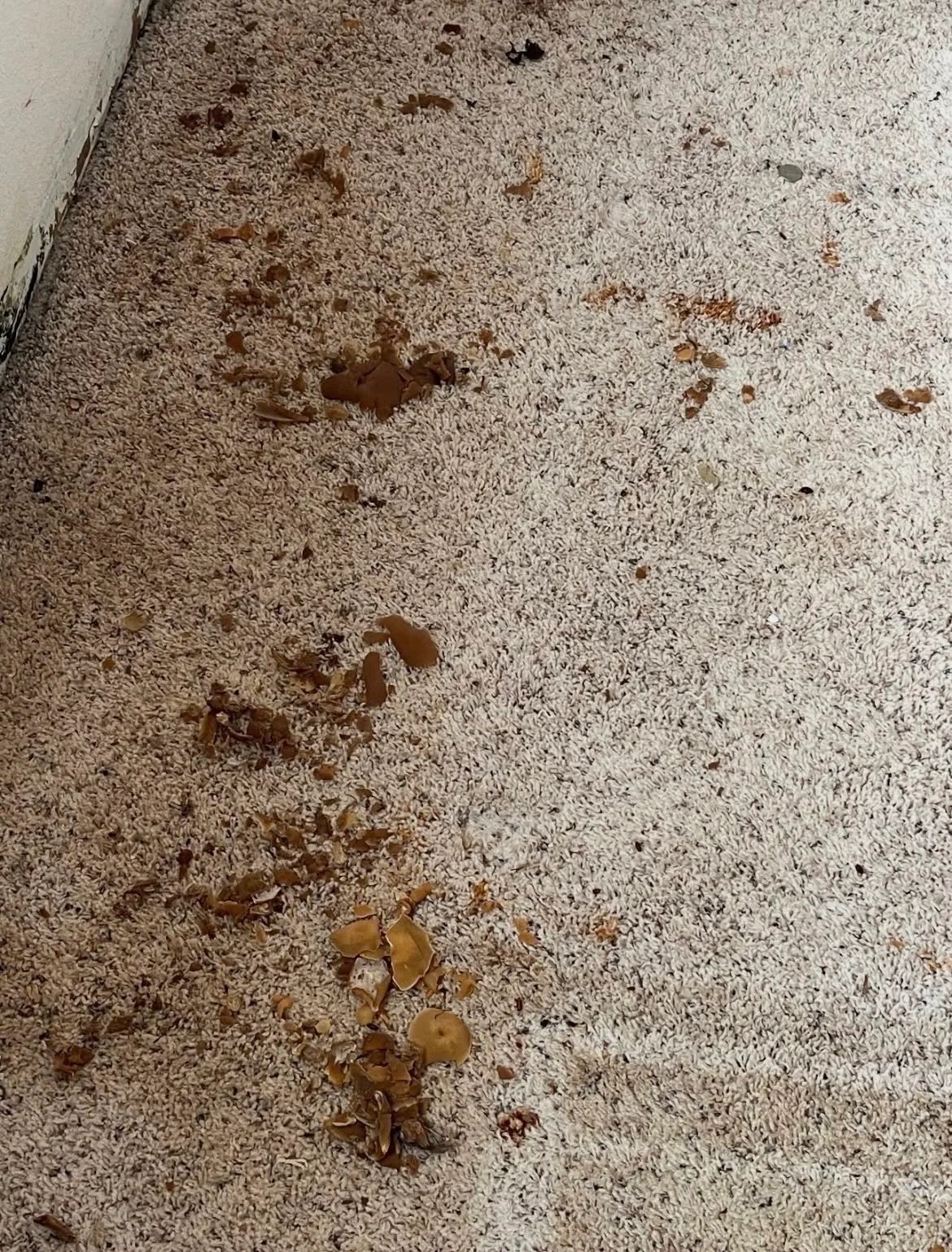
This is the part almost nobody explains. Low ambient humidity means moisture evaporates readily from exposed surfaces — so drywall feels dry, carpet feels dry, and the room smells normal. Behind the drywall, inside the wall cavity, under the pad, the assembly can still be holding water. There is no condensation on the surface to give it away and no musty smell in the room, because the moisture is not reaching the room.
By the time something is visible or you can smell it, growth has usually been established for weeks.
That is why we meter rather than touch. A moisture meter reading against unaffected material of the same type tells you whether an assembly is actually dry. A hand on the wall tells you what the surface is doing, which in this climate is close to meaningless.
Three local situations where we see this pattern repeatedly:
- Post-monsoon crawl spaces. Water gets under the house in late July, nobody goes down there until autumn, and by then the joists have been damp for two months.
- Delayed dry-out after burn-scar flooding. Homes below the Waldo Canyon and Black Forest scars take on water fast during a monsoon cell. If mitigation waits for an adjuster, the clock has already run.
- Empty houses during PCS season. May through August, a home sits closed up mid-move. A slow supply-line leak has nobody to notice it.
Colorado Springs
How fast does mold grow after water damage?
Roughly 24 to 48 hours on wet porous material — drywall paper, carpet pad, insulation, and the cardboard backing on most cabinetry. That window is the reason mitigation is urgent even when the damage looks minor.
The 24 to 48 hours is when growth begins, not when it becomes visible. Visible colonies on drywall usually take longer. So a basement that flooded on Saturday and is still wet on Monday already has a mold component to the job, whether or not anything has appeared yet.
Temperature matters less than people expect. Growth slows in a cold crawl space but does not stop, which is why a winter loss in an unheated space is not safe to leave until spring.
Water on the floor right now?
Tell us where it came from and how long it has been there. We will give you a time, not a window.
24/7 — Colorado Springs and El Paso County
Water damage
What does real mold remediation actually involve?
Five stages. If a quote is missing any of them, ask why.
1. Find and fix the moisture source
Remediation without this is repainting. If the supply line is still weeping, or the crawl space still has no vapour barrier, or the cove joint is still taking on water every time the sprinklers run, the growth comes back — usually within a season. We meter, use thermal imaging to narrow where to meter, and open the assembly if that is the only way to be certain.
2. Containment
Plastic sheeting sealed at the perimeter, with the work area held under negative pressure by a negative air machine venting outside or through HEPA filtration. This is what keeps spores from being distributed through the rest of the house during demolition, which is the single most common way a small mold job becomes a large one.
You will usually be able to stay in the house. That is the point of containment.
3. Removal
Porous material with growth in it comes out — drywall, insulation, carpet pad, ceiling tile. It cannot be cleaned in place because the growth is inside the material, not on it. Semi-porous and non-porous material (framing, concrete, tile, metal) is usually cleaned rather than removed. Wood framing is almost always saveable.
Everything leaves the containment bagged.
4. Cleaning and treatment
HEPA vacuuming of surfaces, then damp wiping, then an antimicrobial where appropriate. Antimicrobial is the last step, not the first — spraying a surface that still has growth on it accomplishes nothing.
5. Verification
Drying the structure back to a documented dry standard, and where the scope justifies it, independent post-remediation verification. Verification is what turns “we cleaned it” into “it is finished.”
Call (719) 618-9013 for a scope you can read and question.
📞 Call (719) 618-9013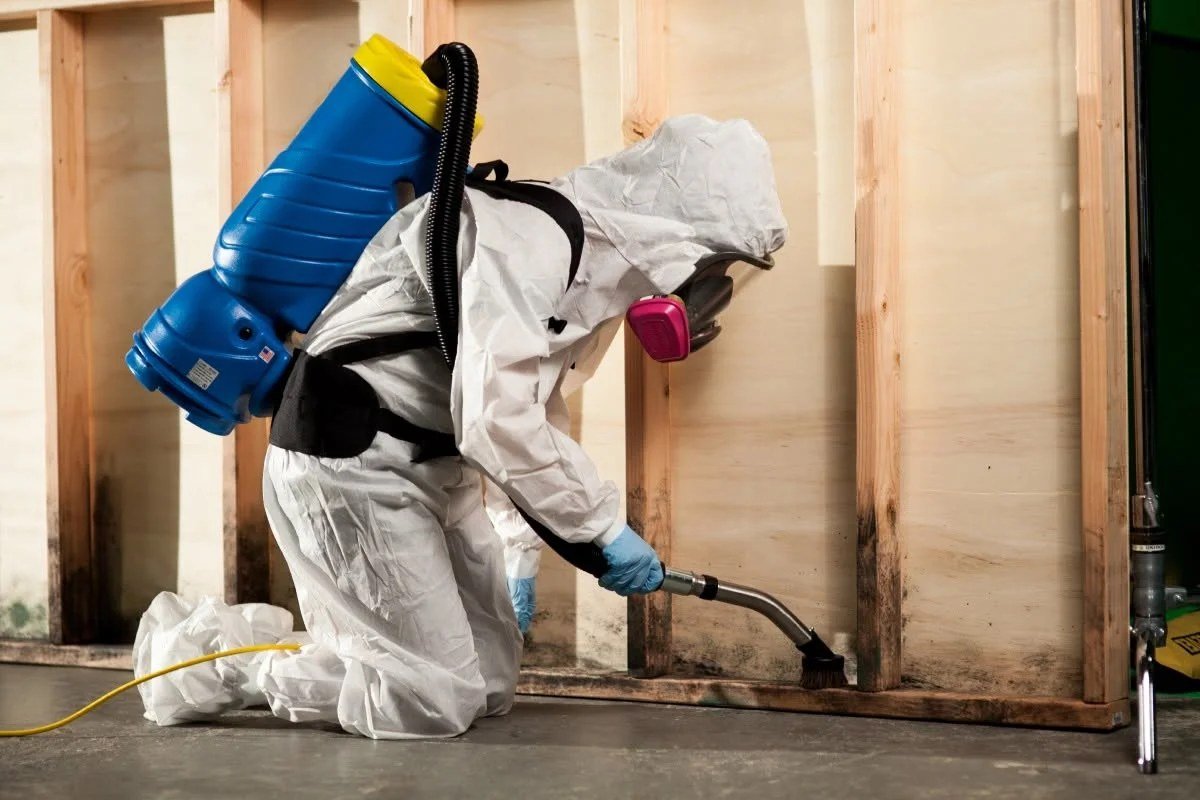
Colorado Springs
Is black mold different from other mold?
Not in the way most people have been told. “Black mold” usually refers to Stachybotrys chartarum, which is dark and grows on very wet cellulose material — soaked drywall, saturated cardboard, wet wood. It does need sustained moisture, so finding it means something has been wet for a long time.
But the remediation is the same regardless of species. You fix the moisture, contain the area, remove the porous material, clean, and verify. Nobody changes the protocol based on colour, and no reputable company should quote you differently because a patch looks black.
Plenty of dark growth is not Stachybotrys at all — Cladosporium and Alternaria are extremely common and also dark. Identifying the species by eye is not possible, and in most cases it does not change what happens next.
Be careful with anyone who leads with the phrase. Fear-selling on black mold is common in this industry and it is the fastest way to spot a company more interested in the invoice than the moisture.
Water damage
Does homeowners insurance cover mold?
Sometimes, and usually with a cap. Most policies cover mold only when it results from a covered water loss that was sudden and accidental — a pipe that burst, an appliance that failed. Even then, many carriers apply a specific mold sublimit that is far lower than the main dwelling limit.
What is almost never covered: mold from long-term seepage, from humidity, from a maintenance issue you knew about, or from flooding. Flood is excluded from standard homeowners policies entirely, which matters here given the burn-scar runoff.
Water damage and freezing carries the highest denial rate of any home insurance claim category, and the reason given is nearly always that the damage was gradual rather than sudden. Mold claims sit right in that crosshair, because mold by definition takes time.
The practical implication: if you have an active leak, mitigating it quickly is not just about the building. It is what keeps the loss on the covered side of that line.
Does homeowners insurance cover water damage in Colorado? → · Sudden and accidental vs gradual damage →
Coverage depends on your specific policy. We are a restoration contractor, not licensed insurance advisers.
Colorado Springs
What does mold remediation cost in Colorado Springs?
It scales with three things: how much porous material has to come out, how much containment the layout requires, and whether the moisture source needs its own repair.
A single wall cavity in a bathroom is a different job from a finished basement where the drywall comes out to four feet around the perimeter. Containment on an open-plan main floor costs more to build than containment on a closed spare room. And if the cause is a failed sump, a cracked lateral or an absent vapour barrier, that repair is its own line.
We publish real local ranges rather than telling you it varies.
Water damage
When do you not need remediation?
If all of these are true, you can handle it yourself:
- The affected area is under roughly 10 square feet
- It is on a hard, non-porous surface — tile, glass, sealed concrete, finished metal
- You know where the moisture came from and it has been fixed
- Nobody in the house has asthma, a mold allergy, or is immunocompromised
- It has not come back after a previous cleaning
Wear gloves and an N95, ventilate, clean with detergent and water rather than bleach (bleach does not penetrate porous material and mostly removes colour), dry the area thoroughly, and keep it dry.
Stop and call if: it returns, it is on drywall or any porous surface, it covers more than about 10 square feet, you cannot identify the moisture source, or anyone in the house has a respiratory condition.
Colorado Springs
What happens when you call
- 1You describe what you are seeing and smelling — where, how big, how long, whether anything has been wet recently.
- 2We tell you honestly whether it needs us. Sometimes the answer is a bag of rags and a fan.
- 3If it does, we inspect and meter before quoting. You get the moisture readings and a written scope, not just a number.
Call (719) 618-9013 — Colorado Springs and El Paso County, 24/7.
📞 Call (719) 618-9013Frequently asked
Questions people actually ask
Do I need a mold test before remediation?
Can I just use bleach?
How long does mold remediation take?
Will the mold come back?
Do you have to remove drywall?
Call Dry Standard Restoration
IICRC-certified. We meter before we quote, and you get the readings.
24/7 — Colorado Springs and El Paso County