Water Damage Peterson Space Force Base & Cimarron Hills
Most water damage Peterson Space Force Base and Cimarron Hills calls have one thing in common: the person phoning is not the person in the house. A deployed spouse, an owner in another state, a housing office with a process. We are set up for that. 80914 and 80915, and someone answers.
- ✓IICRC-certified technicians
- ✓We work to the IICRC S500 standard
- ✓Licensed and insured
- ✓We work with out-of-state owners, property managers and housing offices
- ✓Peterson SFB, Cimarron Hills and east Colorado Springs
Water damage
What makes water damage different around Peterson?
Transient occupancy. Everything else on this page follows from it.
In most neighbourhoods a water loss has one decision-maker standing in the room. Here it routinely has none. The occupant may be deployed, TDY, or mid-move with half the house in boxes. The owner may live in Virginia and have bought the place during a previous tour. If it is on-base housing, the person who decides is a housing office working to a documented process.
Four consequences you do not get in this combination anywhere else in the metro:
Nobody in the building has authority. A tenant cannot authorise structural work. An owner in another state cannot see what we are looking at. So the first thing we establish on these calls is not the water — it is who can say yes, and how fast we can reach them.
Two ZIPs, two completely different processes. 80914 is base housing and runs through a housing office. 80915 is ordinary private rental and ownership in unincorporated county. Same drive, different job.
The calendar stacks against you. PCS season peaks May through August. The monsoon window is mid-July through mid-September. Those overlap by roughly six weeks, so the period with the most empty and half-packed houses in this zone is also the period with the most water arriving.
Empty houses turn small failures into large ones. A supply line that fails in an occupied house is a bucket and a bad evening. In a house nobody has entered for three weeks, it is a fortnight of running water. This is the single largest loss type in the zone, and /emergency-water-removal/ covers the vacancy side in full.
Colorado Springs
Which areas and ZIP codes do we cover here?
Peterson Space Force Base (80914). The installation itself, including privatised family housing. Base housing at Peterson is managed by Tierra Vista Communities, which changes how a water loss gets handled — see the section below.
Cimarron Hills (80915). The residential area immediately east of the base, in unincorporated El Paso County . 1960s through 1980s stock, a high proportion of rentals, and the polybutylene installation window running through much of it.
East along the Airport Road and Peterson Boulevard corridors (80915). A mix of older residential, small commercial and base-adjacent rental, with the Colorado Springs Airport and the base sharing the area’s east–west arterials.
North toward Palmer Park and Village Seven. The boundary with our East Colorado Springs zone, which shares the same 1960s–80s stock and the same pipe problem.
Landmarks that matter operationally rather than scenically: Peterson Space Force Base and its gates, which govern access and therefore response time · the Colorado Springs Airport, which shares the arterial network · Sand Creek to the south and west as the nearest drainage · Powers Boulevard and Airport Road as the routes we actually take.
Water damage
My spouse is deployed and there is water in the house. What do I do?
Shut the water off at the main, then call (719) 618-9013. Do not wait to reach your spouse or the housing office first.
This is the most common version of this call, and it is worth saying plainly: the water does not stop while you find the right person to ask. Every hour of standing water is more material that comes out instead of drying in place, and mold begins to establish in roughly 24 to 48 hours in saturated drywall and carpet pad.
What to do, in order:
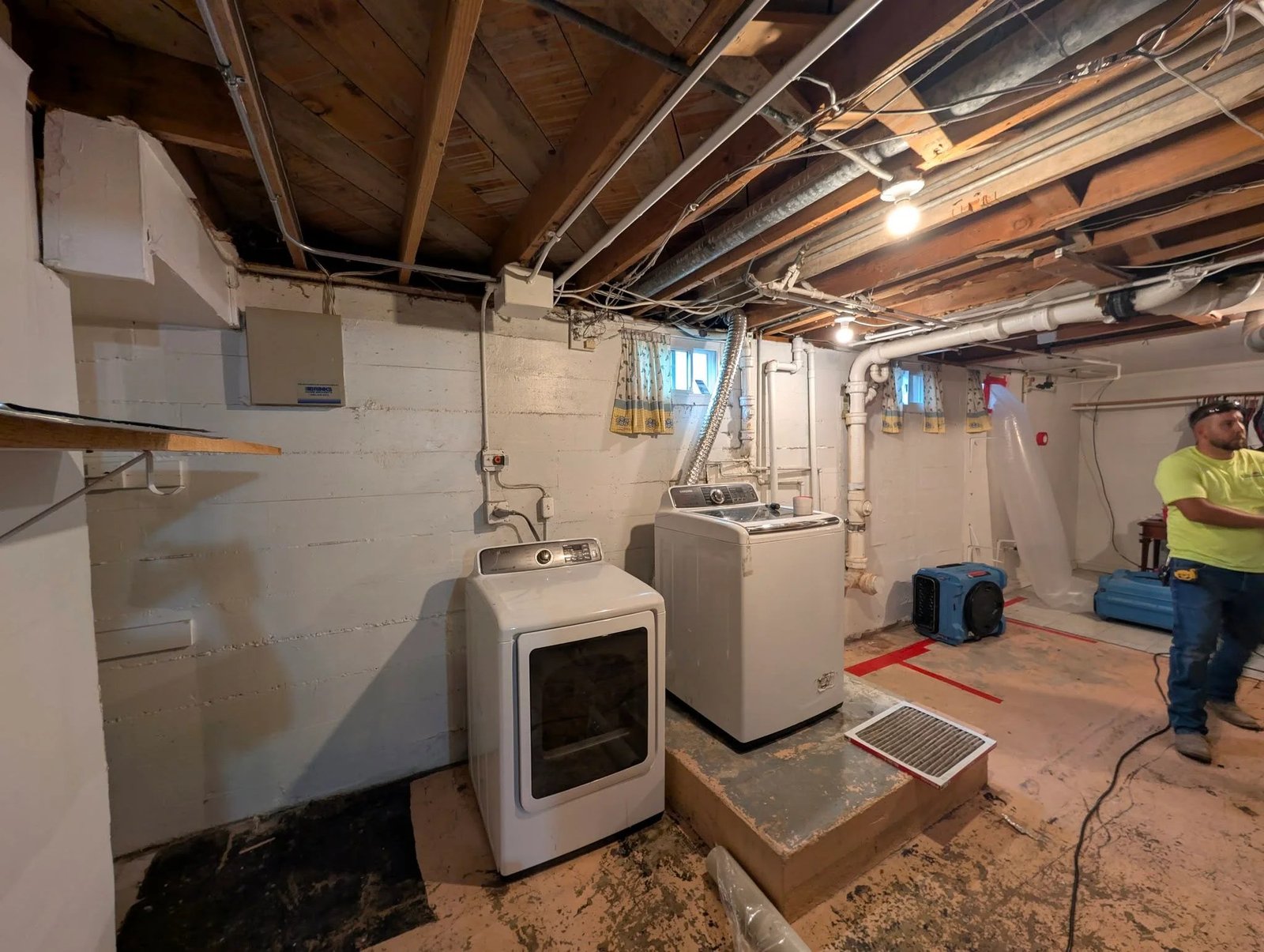
- 1Shut off the main. In this housing stock it is usually in the basement on the street-facing wall, in a utility or laundry room, or in the garage. If it will not turn, do not force it — tell us on the phone.
- 2Kill power to the affected area at the breaker if you can reach the panel without standing in water. If you cannot, leave it and tell us.
- 3Photograph everything before you move it. Wide shots and close shots, timestamped by your phone. This is the record every party will later work from.
- 4Call us. We will meter, document and stabilise, and we will hold the full scope until whoever has authority approves it.
- 5Then notify the housing office if you are in base housing, or the owner and property manager if you are renting privately.
And the honest part: stabilising a building to prevent further damage is a different decision from committing to a full restoration scope. We will separate those two things for you explicitly, so that nobody signs for work they had no authority to approve. If it turns out the right answer is a mop, two towels and an open window, we will tell you that and leave — no charge for the conversation.
Colorado Springs
Who has authority to approve the work when nobody is home?
It depends on which of three situations you are in, and getting it right at the start saves days later.
On-base housing at Peterson (80914). Housing is privatised through Tierra Vista Communities, so the property manager — not the resident, and not us — controls maintenance and repair. The resident reports it; the housing office dispatches or approves. If you live in base housing, report it to your housing office first and follow their process. We work alongside privatised housing managers, but we do not walk into base housing and start cutting drywall because a resident asked us to. That is not how it works and anybody who tells you otherwise has not done it.
Private rental in Cimarron Hills (80915). The owner insures the structure; the tenant’s renters policy covers the tenant’s belongings. Mitigation to prevent further damage is normally the owner’s call, and most policies place a duty on the owner to prevent further damage — which is exactly why an overnight delay costs more than the first night of equipment. If the owner is out of state and unreachable, we document, stabilise, and wait on scope.
Owner-occupied, occupant away. A spouse, a parent with a key, or a neighbour can let us in and can authorise emergency stabilisation. Full scope waits for the owner. We will get you on a call, send photographs and readings, and talk through the scope before anybody commits.
What we do in all three cases: one document — moisture readings, dated photographs, a written scope, what came out and why — shared with every party who has a stake in it. When a loss involves a resident, an owner and a housing office, the ones that resolve cleanly are the ones where everybody is working from the same file rather than three different phone calls.
Water on the floor right now?
Tell us where it came from and how long it has been there. We will give you a time, not a window.
24/7 — Colorado Springs and El Paso County
Water damage
Who is my water utility here — and who shuts the water off in the street?
This is the question that catches people out in Cimarron Hills, and getting it wrong at 2 a.m. costs you an hour.
Inside the City of Colorado Springs, the utility is Colorado Springs Utilities. The demarcation between their responsibility and the property owner’s runs at the right-of-way or public utility easement line adjacent to the distribution main where the service line taps in. The curb stop is the ownership boundary, and only Utilities may operate a curb stop — you may not, and neither may we. (Colorado Springs Municipal Code §12.4.409.)
Cimarron Hills is in unincorporated El Paso County, and water and wastewater service there is not necessarily Colorado Springs Utilities. Confirm your provider now, while it is a five-minute job, rather than at 2 a.m. with water crossing the basement floor. Look at your water bill — the name on it is your answer, and the emergency number on it is the one you need.
Why it matters practically:
- A break between the street and your house is an outside-the-building problem, and only the utility that owns that curb stop may operate it. Calling the wrong one wastes the worst possible hour.
- Freeze-thaw drives main breaks. Colorado Springs Utilities itself attributes elevated main break rates to the freeze-thaw cycle, and El Paso County crosses 32°F repeatedly in a single day through the cold months.
- Cleanup starts regardless of whose pipe failed. Whoever owns the break, the water in your building is still your building’s problem, and the clock on materials is running.
What we tell every household in this zone to do once: find the main shutoff inside the building, confirm it actually turns, and write your water provider’s emergency number on the inside of a cupboard door. Three jobs, fifteen minutes, and it is the difference between a wet floor and a wet floor plus a wall.
Colorado Springs
Why does PCS season produce so many water losses here?
Because the moving calendar and the weather calendar overlap, and empty houses do not report problems.
PCS peaks May through August. The North American monsoon window runs roughly mid-July through mid-September, and flash flooding is the most common natural hazard in Colorado Springs according to the City’s Office of Emergency Management. Those two windows overlap by about six weeks — which is the busiest moving period in a four-installation metro sitting on top of the wettest, most intense-rainfall period of the year.
What actually goes wrong:
Nobody is there to notice. A house between tenants, or one where the family has flown ahead of the movers, has no one to hear a running toilet, spot a damp patch, or notice the water bill. The failure is not worse — the discovery is later, and discovery time is what determines whether you are drying a room or rebuilding one.
Half-packed houses hide water. Boxes on a basement floor absorb and conceal. We have opened plenty of cartons that were the only reason anyone eventually noticed.
Utilities get turned down or off. Heat set low, or a water heater left on in an empty house with no one to see the drip tray.
Appliance disconnections. Washer hoses and fridge lines disturbed during a move, then reconnected in a hurry or left capped badly, are a genuinely common failure at exactly this time of year.
The winter version is worse. A mid-tour or winter PCS leaves a house empty through freeze season, and burst risk climbs sharply below about 20°F with six or more hours of exposure. An empty house with the heat set low is the highest-risk building in this zone, every January.
One honest limitation worth stating: if your house is going to stand empty, the most useful thing you can do costs nothing and does not involve us. Shut the water off at the main and drain the system. A house with no water in the pipes cannot flood from a pipe. If that is not practical, have somebody physically walk through it weekly — not check it from an app, walk through it. Most of the large losses we see in this zone would have been small ones with either of those two things in place.
Water damage
What is the housing stock like in Cimarron Hills, and how does it fail?
1960s through 1980s, and it fails mostly at the supply pipe.
That build range puts a great deal of 80915 inside the polybutylene installation window of roughly 1978 to 1995 — grey, flexible plastic supply pipe that degrades from the inner wall outward and often fails suddenly, at full pressure, with no drip stage first. Some of the older stock also still carries original galvanised steel supply, which fails the opposite way: corroding from the inside until a pinhole opens.
The zone-specific problem is not the pipe. It is the pipe plus the occupancy.
A polybutylene failure in an occupied house is a bad afternoon. The same failure in a rental between tenants during PCS season runs until someone opens the door. That combination — the metro’s most failure-prone supply pipe under its most transient occupancy — is what makes this zone’s average loss larger than its average cause would suggest.
Other failure modes we see repeatedly here:
- Water heater ruptures. Hard water shortens tank life, and in this stock the heater is often in a utility room rather than a garage, so the water has somewhere finished to go.
- Washer and dishwasher supply failures, concentrated around move-in and move-out.
- Slab and crawl space leaks found late, because a single-storey house of this era runs its supply horizontally rather than stacked.
- Cove joint seepage after a wet cycle — expansive bentonite clay taking on water, swelling, and pressing against the foundation until water works through the seam where the slab meets the wall. The Colorado Geological Survey treats expansive soil as a named statewide hazard. This one shows up two or three days after the storm, not during it.
- Sewer backups from root intrusion and storm surcharge into the sanitary main during monsoon cells.
Identifying your pipe takes ten seconds and we cover it properly on the East Colorado Springs page, which shares this exact housing stock. Grey, flexible, often stamped PB2110.
Colorado Springs
Will renters insurance or the owner's policy cover this?
The split is straightforward. What is not straightforward is the vacancy question, and that is where people in this zone get hurt.
The general division, before anyone’s specific policy language:
- The owner’s policy covers the building and the owner’s own property in it.
- The tenant’s renters policy covers the tenant’s belongings, and often temporary accommodation while the place is uninhabitable.
- Neither covers the other party’s property. Both parties usually need to file.
- On-base housing follows the housing provider’s process, and a resident’s personal property still sits with their own renters policy.
The vacancy problem. Many policies restrict or exclude freeze-related damage when a property has been vacant or unoccupied and reasonable steps were not taken — maintaining heat, or shutting off and draining the water supply. In a zone built on PCS turnover, this is the single most consequential clause in the document. /emergency-water-removal/ sets it out in full, and it is worth reading before you leave a house empty rather than after.
Two more things worth knowing before you file:
- Sudden and accidental versus gradual decides most water claims. A supply line that lets go at pressure on a Tuesday is sudden. The same pipe seeping quietly for eight months behind a wall is gradual, and gradual damage and long-term seepage are excluded under most policies. In a house nobody has been in for a month, “when did this start” is a genuine question, which is exactly why the dated photograph and the written report matter so much here.
- You will be settled on ACV or RCV. Actual cash value pays depreciated value. Replacement cost value pays the full cost, usually with recoverable depreciation released once the work is done and evidenced. Know which one you have before agreeing a scope.
We work directly with carriers and document to Xactimate scope conventions, because a scope an adjuster can read is a scope that gets paid — and when the policyholder is eight time zones away, the paperwork is doing the arguing on their behalf.
General information, not a coverage determination. Your policy language governs, and we are a restoration contractor rather than licensed insurance advisers.
Water damage
How fast can you reach Peterson and Cimarron Hills — and can you get on base?
Cimarron Hills is a routine, quick run for us. Peterson itself depends on the gate, and that is not a delay we control.
Here is the honest version, because an optimistic number is worth nothing to somebody trying to plan from overseas.
Cimarron Hills and the Airport Road corridor (80915) — among the quicker addresses in the metro for us. You get a time, not a window.
Peterson Space Force Base (80914) — access is controlled by the installation, and base access requirements are set by the base, not by us. Realistically that means an escort, a sponsor, or a contractor credential, and it means the housing office is usually the fastest route to getting a crew through the gate. We will tell you honestly on the phone what our access position is for your specific situation rather than promising a time we cannot hold.
Two things that genuinely move the clock here:
Access, not distance. The most common delay on jobs in this zone is not driving — it is arriving and waiting. A gate, a key, a housing office that opens at eight, a neighbour who was supposed to be home. Tell us on the phone who can physically open the door, including the mechanical room and any crawl space hatch, because that conversation saves more time than any route.
A regional storm commits everybody. During a hail event or a monsoon cell sitting over the Powers corridor, every crew in southern Colorado is working at once. We will tell you where you are in the queue rather than quoting you a number we already know we will miss.
Call (719) 618-9013. Tell us the ZIP, whether it is base housing or private, whether it is a slab, crawl space or basement, whether the water is still coming in — and who can let us in.
📞 Call (719) 618-9013Colorado Springs
What happens when you call
- 1Five questions. Where the water came from, how long it has been there, what it has reached, whether it is base housing or private, and who can authorise the work.
- 2A time, not a window — and an honest access answer if the address is on base.
- 3We meter before we quote, and you get the readings and the photographic record — one document, shared with every party who needs it, including an owner or housing office who was never in the building.
Call (719) 618-9013 — Peterson Space Force Base, Cimarron Hills and east Colorado Springs, 24/7. Away from home? Call and we will coordinate with whoever is on site.
📞 Call (719) 618-9013Frequently asked
Questions people actually ask
I am deployed and my spouse says the basement is flooded. What do I tell them?
Who is responsible for water damage in Peterson base housing?
Is Cimarron Hills served by Colorado Springs Utilities?
My rental in Cimarron Hills flooded and the owner lives out of state. Can you still start?
What should I do with the house if we are PCSing over the summer?
Why do we get so many water calls in Cimarron Hills specifically?
Water is coming up through the basement floor drain — is that covered?
Can you get a crew onto the base?
Call Dry Standard Restoration
IICRC-certified. We meter before we quote, and you get the readings.
24/7 — Colorado Springs and El Paso County