Sewage Cleanup in Colorado Springs
Do not go in it, and do not try to clean it up. Sewage is Category 3 water — it carries pathogens, and the porous materials it has touched cannot be disinfected in place. Call (719) 618-9013.
- ✓IICRC-certified technicians
- ✓Category 3 containment protocol
- ✓Licensed and insured
- ✓Colorado Springs and El Paso County
Water damage
Is it safe to be in the house?
Keep everyone out of the affected area — people, and pets especially, because they will walk through it and then walk through the rest of the house.
Immediate steps:
- Stop using water in the building. Every flush, every sink, every washing machine cycle adds to what is backing up.
- Do not run the HVAC. Forced air will move contamination and odour through the whole house.
- Cut power to the affected area at the breaker if the panel is dry and you can reach it safely. If not, leave it and say so when you call.
- Close interior doors to the affected room to slow the spread of airborne contamination.
- Do not start pulling material out. It needs documenting first, and it needs containment before it moves.
If sewage has reached a bedroom, a kitchen, or the only bathroom, tell us when you call. That changes the sequence we work in.
Call (719) 618-9013. Tell us where it came up and roughly how far it has spread.
📞 Call (719) 618-9013Colorado Springs
Why did this happen?
Three causes account for most of what we see in Colorado Springs, and which one you have changes who is responsible for the repair.
Monsoon surcharge
During heavy rain — particularly the mid-July to mid-September monsoon window — stormwater infiltrates the sanitary sewer system and the mains surcharge. When the main is full, the lowest fixture on the lowest floor of the nearest building becomes the relief point. That is usually a basement floor drain, a basement toilet, or a shower.
If your basement backs up during a hard rain and stops when the rain does, this is almost always why.
Root-intruded clay laterals
The older Westside, Old Colorado City, downtown and the Old North End have mature trees and original clay sewer laterals. Clay pipe joins at every section, roots find the joints, and over decades the intrusion narrows the pipe until it blocks. This is a slow-developing failure that presents suddenly.
Housing stock matters here: Old Colorado City averages around 1909 construction. A century-old lateral under a mature cottonwood is a known quantity.
Septic failure
Black Forest, Falcon, parts of Security-Widefield and the far-east rural ZIPs are on septic rather than municipal sewer. Systems fail from a saturated leach field after prolonged wet weather, from an overdue tank pump-out, or from age. A saturated field during monsoon season backs up into the house because it has nowhere else to go.
Water damage
Is this Colorado Springs Utilities' problem or mine?
This is the question everyone asks and almost nobody answers accurately, so here is what the rules actually say.
The demarcation point between Colorado Springs Utilities’ responsibility and the property owner’s, for the maintenance, repair or replacement of a service line, is the right-of-way or public utility easement line adjacent to the distribution main where the service line tap is located.
The curb stop is the ownership boundary. Curb stops are jointly owned by the property owner and Utilities, but only Utilities may operate, maintain, repair or replace a curb stop, and Utilities is solely responsible for that operation and maintenance. Utilities repairs and replaces curb stops that it damaged, or that it determines are defective or at end of life. Where the damage resulted from the property owner’s own installation or operation, the owner reimburses Utilities for the cost.
Source: Colorado Springs Utilities service line responsibility guidance and Colorado Springs Municipal Code §12.4.409.
In plain terms: the line from the main to roughly your property line is generally theirs. The line from there into your house is generally yours. If the blockage is in your lateral, it is your repair. If the main surcharged, that is a different conversation — and Colorado Springs Utilities maintains a wastewater backup policy worth reading before you assume either way.
Report a suspected main problem to Colorado Springs Utilities directly. Do not wait to find out whose it is before calling us — the cleanup clock runs regardless of who ends up paying for the pipe.
Water on the floor right now?
Tell us where it came from and how long it has been there. We will give you a time, not a window.
24/7 — Colorado Springs and El Paso County
Colorado Springs
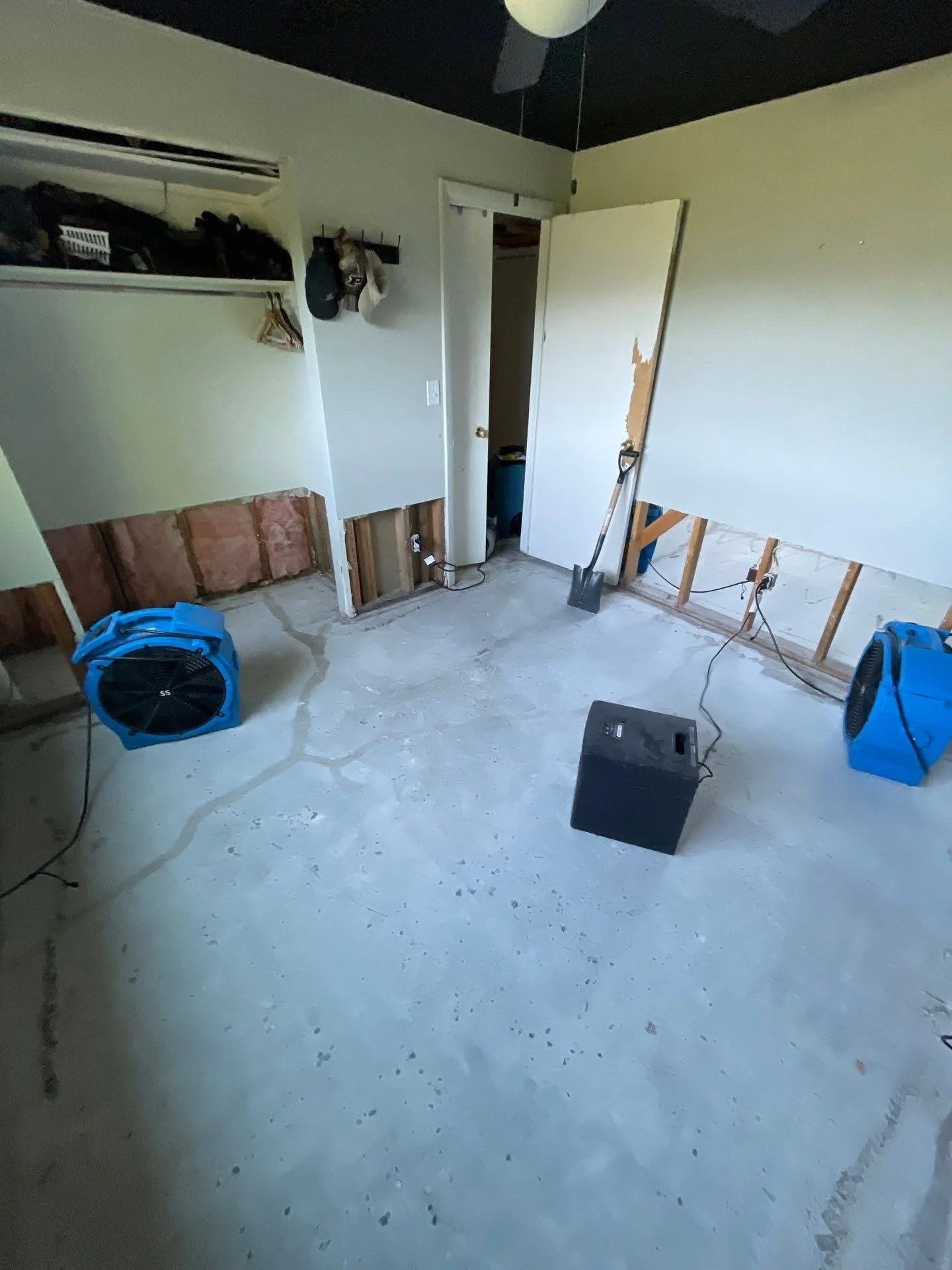
What has to be thrown away?
With Category 3 water the rule is porosity. Anything porous that the water touched cannot be reliably disinfected, because the contamination is inside the material rather than on it.
Comes out:
- Carpet and pad, without exception
- Drywall to a line above the contamination — typically a flood cut
- Batt insulation
- Particleboard and MDF cabinetry, including the toe kicks
- Upholstered furniture and mattresses
- Paper, cardboard, books
- Wooden trim and baseboard that was in contact
Cleaned and saved:
- Framing lumber, in nearly every case
- Concrete, block, tile and sealed masonry
- Glass, metal, hard plastics
- Solid wood furniture in most cases
- Hard contents that can be washed and disinfected
Everything that leaves is photographed and documented. That inventory is what your claim is built from, so it is worth getting right rather than fast.
Water damage
How is Category 3 cleanup different?
The contamination changes the whole sequence. On a clean-water loss you extract, dry and verify. Here:
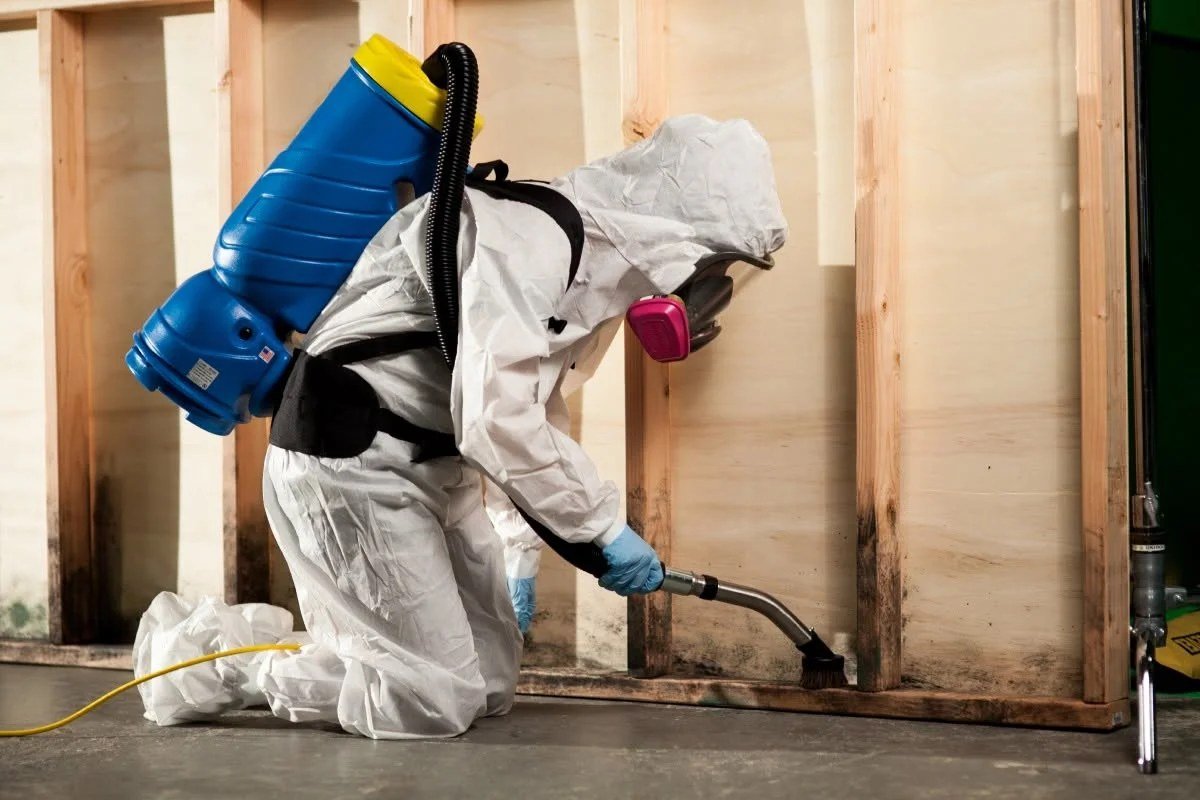
- 1Containment before anything moves. Sealed plastic barriers, work area under negative pressure through HEPA filtration. Without this, demolition aerosolises contamination into the rest of the house — which is the most common way a contained problem becomes a whole-house problem.
- 2Protective equipment. Full coveralls, gloves, boots and respiratory protection. This is standard for Category 3, not theatre.
- 3Bulk removal and extraction, with solids handled separately.
- 4Porous material out, bagged inside the containment and removed without crossing clean areas.
- 5Cleaning, then disinfection. HEPA vacuum, damp wipe, then an antimicrobial. In that order — treating a dirty surface accomplishes nothing.
- 6Structural drying to a documented dry standard, verified with meter readings against unaffected material of the same type.
- 7Verification before reconstruction.
The work is done under the IICRC S500 standard for water damage and, where growth is involved, S520 for microbial remediation.
Colorado Springs
Does insurance cover sewage backup?
Usually only if you have the endorsement, and a lot of people do not.
Standard homeowners policies frequently exclude water that backs up through sewers or drains. Coverage typically comes from a sewer and drain backup endorsement — an add-on with its own limit, often modest relative to what a finished basement costs to restore.
Worth knowing before you call your carrier:
- Check whether you have the endorsement and what the limit is. It is commonly a few thousand dollars, which does not go far in a finished basement.
- Backup from a municipal main surcharge may involve a claim against the utility as well as your carrier, depending on circumstances. Document heavily either way.
- Septic failure is often treated differently again, and maintenance-related failure is a common denial ground.
- Flooding from outdoors that entered through a floor drain may be treated as flood, which standard homeowners policies exclude entirely.
Water damage and freezing carries the highest denial rate of any home insurance claim category, and gradual or maintenance-related causes are the usual stated reason. A lateral that has been slowly root-blocking for ten years sits uncomfortably close to that line.
Coverage depends on your specific policy. We are a restoration contractor, not licensed insurance advisers.
Water damage
How long until the house is usable again?
Cleanup and removal is typically one to two days for a residential backup. Structural drying adds another three to five. Reconstruction — new drywall, flooring, trim, cabinetry — is a separate phase and depends on scope and materials.
You can usually stay in the house. Containment is built so the unaffected areas remain usable. If the backup reached the only bathroom or the kitchen, we will tell you honestly that staying elsewhere for a few days is easier.
Odour is the thing people ask about most. Once the contaminated porous material is out and surfaces are cleaned and treated, the smell goes. Odour that persists after that usually means something porous was left in place.
Colorado Springs
Do you serve my part of Colorado Springs?
Colorado Springs and El Paso County. The areas we see sewage work most:
- Downtown, Middle Shooks Run, Old North End (80903, 80907) — original clay laterals, mature trees, pre-1940 stock
- Westside, Old Colorado City, Pleasant Valley (80904, 80905) — the oldest housing and the oldest sewer infrastructure in the city
- Southeast, Hillside, Wildflower (80910, 80916) — post-war stock with ageing municipal sewer
- East Colorado Springs, Knob Hill, Village Seven (80909, 80917) — 1950s–70s stock, high rental density
- Black Forest and Falcon (80908) — septic, no municipal sewer, longest drive times
- Security-Widefield and Fountain (80911, 80925) — high water table, some septic
Frequently asked
Questions people actually ask
Can I clean sewage myself?
How long before it is safe?
Do you replace the flooring?
What if it came from my septic system?
Will the smell come back?
Call Dry Standard Restoration
IICRC-certified. We meter before we quote, and you get the readings.
24/7 — Colorado Springs and El Paso County