Water Extraction in Colorado Springs
Get the standing water out first. Every gallon extracted is a gallon the dehumidifiers do not have to pull out of the air over the next four days — which is why extraction, not drying, is the first thing that happens.
- ✓IICRC-certified technicians
- ✓Truck-mount and portable extraction
- ✓Licensed and insured
- ✓Colorado Springs and El Paso County
Water damage
What should I do before anyone arrives?
Shut the water off at the main if the source is inside the building. Cut power to the affected area at the breaker if the panel is dry and you can reach it safely. Photograph everything in place before you move it — your insurer wants the loss documented where it happened, and moving things first is the most common documentation mistake people make.
Then get what you can off the floor. Furniture legs stain carpet, cardboard boxes wick water upward and collapse, and anything paper or fabric sitting in it will not survive the wait. Lift, do not drag.
Do not enter the water at all if it came from a sewer line, a septic system, or from outdoors. That is Category 3 water — it carries pathogens, and it needs containment and protective equipment.
Call (719) 618-9013. Tell us where the water came from and roughly how much. That decides what comes on the truck.
📞 Call (719) 618-9013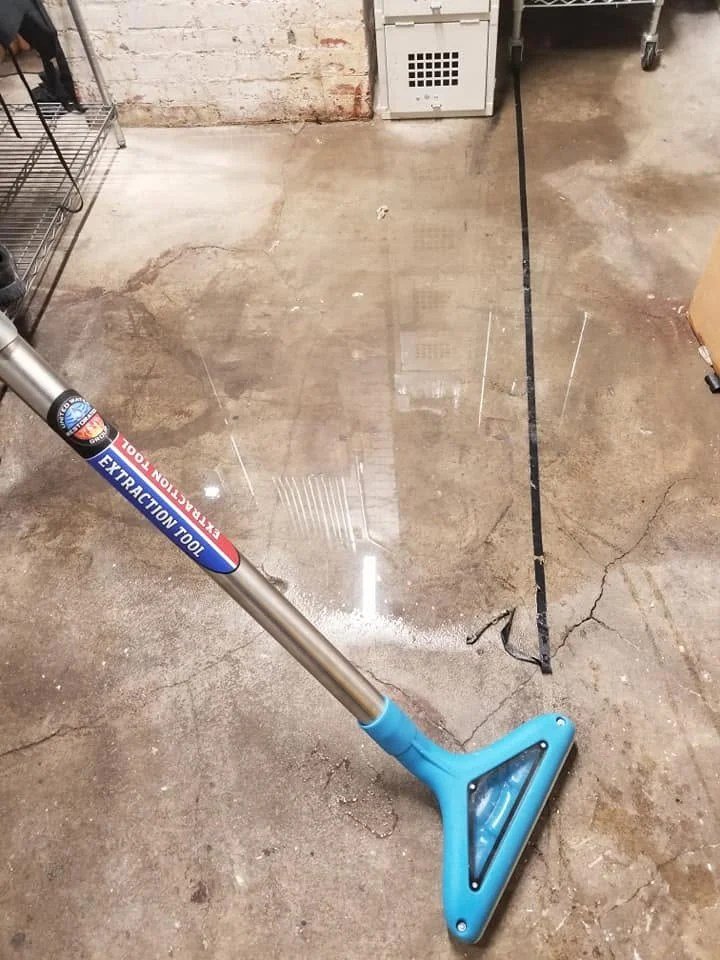
Colorado Springs
Where is the water actually coming from?
This is the question that changes everything else, and in Colorado Springs the answer is often not what people expect.
If there is water along the edges of your basement floor and no leak upstream
That is almost certainly cove joint seepage, and it is not a plumbing failure. The cove joint is the seam where your basement floor slab meets the foundation wall. El Paso County sits on expansive bentonite clay, which swells as it takes on water and presses against the foundation. The Colorado Geological Survey treats expansive soil as a named statewide hazard.
After a heavy irrigation cycle, a monsoon storm, or spring melt, that pressure pushes water through the seam. It appears at the perimeter of the floor, spreads inward, and no plumber will find a source — because there is not one inside the house.
If water is coming in at a window
Window wells and egress wells fill faster than most people think during a hard rain, especially where the well drain has silted up or was never connected. Once the water level passes the sill, it comes through the frame. One local homeowner described water coming in through the window wells and flooding a basement area that was six feet deep. That is not unusual here in a monsoon cell.
Other common sources, in rough order of frequency
- Supply line and appliance failures — washer hoses, fridge lines, dishwashers, water heaters. The most common year-round loss.
- Burst pipes, concentrated December to February, in crawl spaces, garages, north-facing exterior walls and homes sitting empty with the heat low
- Sewer backup — municipal surcharge during monsoon storms, or root intrusion in the older clay laterals on the Westside and downtown
- Roof and hail intrusion — hail opens the envelope, the next storm brings the water in
Water damage
Is this water safe to be around?
It depends which of three categories it is, and the answer changes what can be saved.
- Category 1 — clean water. From a supply line, a water heater, a melting appliance line. Safe on contact. If it sits for more than about 48 hours, or passes through contaminated material, it degrades to Category 2.
- Category 2 — grey water. Significant contamination. Dishwasher and washing machine discharge, toilet overflow from the bowl only, seepage through a foundation wall. Not immediately dangerous but not something to sit in.
- Category 3 — black water. Grossly contaminated. Sewage, septic backup, any flooding from outdoors, and anything that has been standing long enough to grow. Requires containment and protective equipment, and porous materials it touched cannot be disinfected in place.
The category is set by the source and by time, not by how it looks. Clear water from a sewer line is still Category 3.
Water on the floor right now?
Tell us where it came from and how long it has been there. We will give you a time, not a window.
24/7 — Colorado Springs and El Paso County
Colorado Springs
How is standing water actually removed?
In a sequence, and the order matters.
1. Bulk water first. Submersible pumps for anything deep enough to pump — a flooded basement, a crawl space with standing water. Pumps move volume, not detail.
2. Truck-mount or portable extraction. A truck-mounted unit has far more vacuum and heat than a portable, and it dumps to the truck rather than needing to be emptied. Portables get used where the hose run is too long or access is awkward — upper floors, tight stairwells, some commercial interiors.
3. Weighted extraction on carpet. A weighted extraction head presses the carpet and pad against the tool while drawing vacuum, which pulls far more water than passing over the surface. Slow passes beat fast passes every time. This is the step that decides whether a carpet is saveable.
4. Detail extraction. Wands into corners, along the wall base, under the toe kicks of cabinet runs, and anywhere water has tracked under a fixed obstruction.
Extraction is not drying. It removes free water — the water you can see and reach. What is left is bound into the materials, and that comes out through structural drying over the following days.
Water damage
What about the carpet and the pad?
The carpet is often saveable. The pad usually is not.
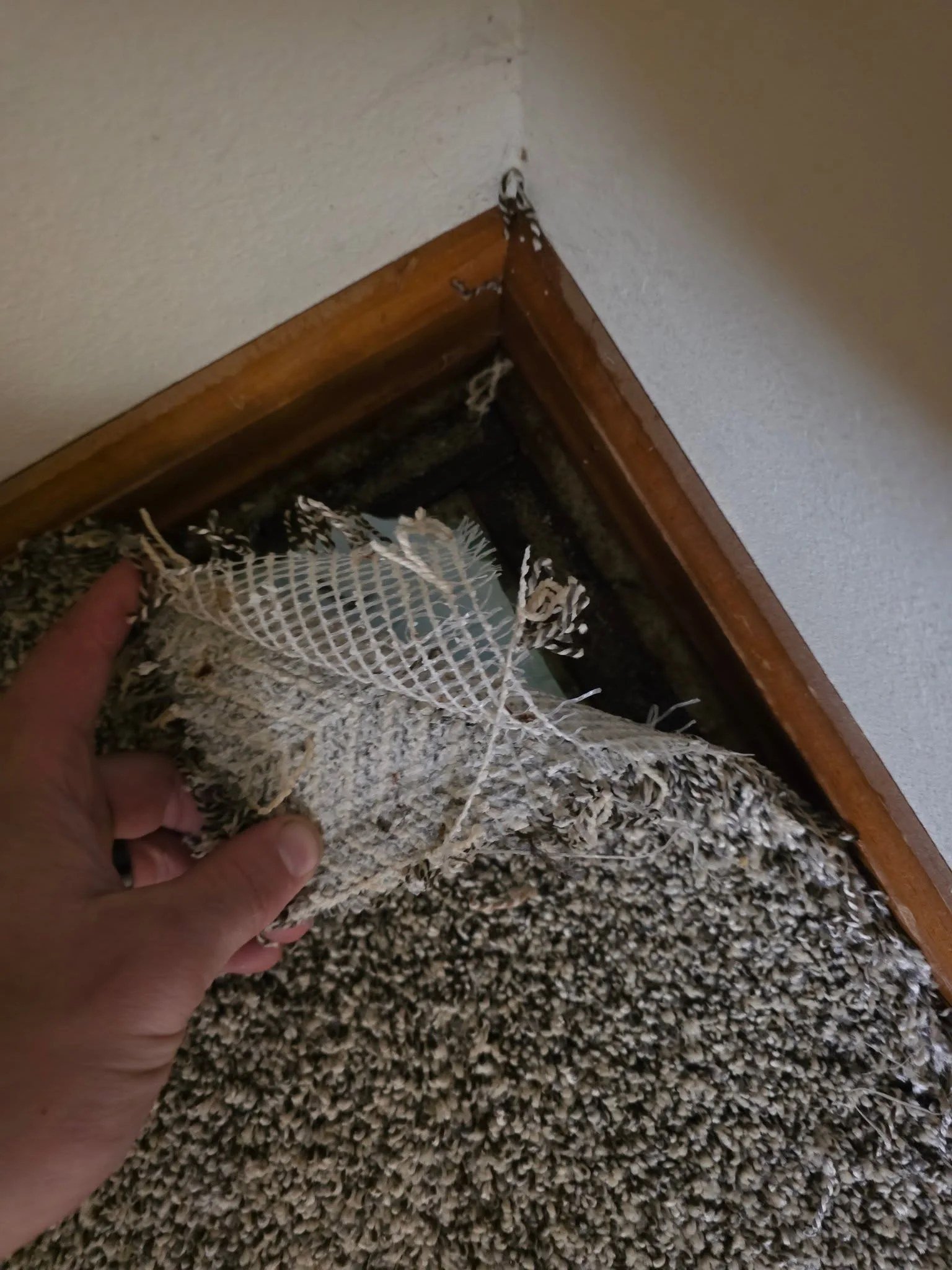
Carpet pad is designed to be absorbent and it holds several times its weight in water. It is also cheap to replace relative to the labour of trying to dry it in place. On a Category 1 loss caught quickly, we will sometimes float the carpet — lift it, remove the pad, and dry the carpet and subfloor from underneath with air movers. On Category 2 or 3, the pad goes without discussion and the carpet usually follows.
The thing that decides it is the backing. If the carpet backing has delaminated — separated from the face fibres — the carpet is finished regardless of category. You can feel it: the surface moves independently of the backing when you lift a corner.
Colorado Springs
Why does speed matter this much?
Because two clocks start when the water arrives, and neither one pauses.
The mold clock: roughly 24 to 48 hours on wet porous material — drywall paper, carpet pad, insulation, cabinet backing. Growth begins in that window whether or not anything is visible.
The migration clock: water moves. It wicks up drywall, travels along the underside of subfloor, runs down inside stud bays, and gets under floor coverings that will not release it. Every hour it sits, the wet area is larger than it was. A loss that was two rooms on Saturday morning is frequently four by Sunday night.
That second clock is the one that drives cost, because scope is what you pay for. This is also why the insurance answer favours acting fast — most policies impose a duty on you to prevent further damage, and delaying mitigation to wait for an adjuster works against you rather than for you.
Water damage
Do you serve my part of Colorado Springs?
Colorado Springs and El Paso County. From our base in the 80909 area we reach most of the metro quickly — the Powers corridor, downtown and Shooks Run, the Westside and Old Colorado City, Broadmoor and Skyway, the southeast, Briargate and Northgate, and the northeast ZIPs out through Wolf Ranch.
Some areas are a genuine drive and we will say so on the phone rather than after you have waited: Black Forest and Falcon (80908), the far-east rural ZIPs past Banning Lewis Ranch (80928, 80929, 80930), and the Monument end of the county.
Colorado Springs
When you do not need us
If it is clean supply water, under roughly 10 square feet, on a hard floor or on carpet you can lift, and you caught it the same day — a wet vac and a couple of fans will handle it.
Pull the carpet back, get the pad out, run a fan across the area at a low angle and a dehumidifier in the room with the door shut, and check it in 48 hours.
A shop vac will not: get water out of carpet pad, pull it back out of drywall, or tell you whether the subfloor underneath is still wet. Those are the three things that decide whether a small job stays small.
Call if it still feels damp after two days, if a musty smell develops, if it reached drywall or insulation, or if it was anything other than clean water.
Water damage
What happens when you call
- 1Three or four questions. Where the water came from, how long it has been there, what it has reached, whether it is still coming in. That decides the equipment.
- 2A time, not a window. If it is two hours, we say two hours.
- 3Extraction starts, then we meter. Scope and quote come from readings, not from a look around.
Call (719) 618-9013 — Colorado Springs and El Paso County, 24/7.
📞 Call (719) 618-9013Frequently asked
Questions people actually ask
Can I just use a shop vac?
How long does extraction take?
Do you have to remove the carpet?
What about the pad underneath?
Will you move my furniture?
Call Dry Standard Restoration
IICRC-certified. We meter before we quote, and you get the readings.
24/7 — Colorado Springs and El Paso County