Mold Inspection in Colorado Springs
A mold inspection finds where moisture is getting in and how far it has travelled. Testing tells you what species is present — which, most of the time, will not change what happens next.
- ✓IICRC-certified technicians
- ✓Moisture mapping and thermal imaging
- ✓Colorado Springs and El Paso County
Water damage
What does a mold inspection actually include?
A proper inspection is a moisture investigation, not a look around. It should cover:
- A visual survey of the affected area and every space that connects to it — including the crawl space, the attic, and behind removable panels
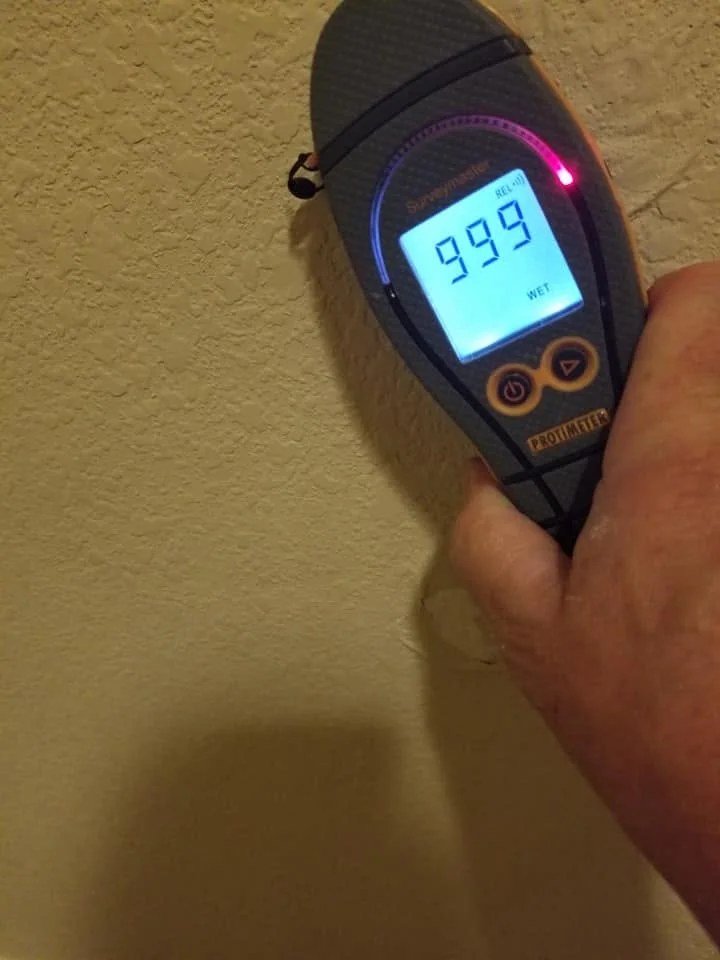
- Moisture mapping with a pin and pinless meter, reading affected material against unaffected material of the same type so the numbers mean something
- Thermal imaging to narrow where to meter. Thermal cameras show temperature difference, not moisture — a cold patch is a clue, not a result
- Relative humidity and temperature readings in each affected space, because the psychrometrics tell you whether the environment will dry or keep feeding growth
- A written report with the readings, photographs, the suspected source, and a scope if remediation is warranted
What it should not be: someone glancing at a wall, saying “that looks like black mold,” and handing you a remediation quote on the spot.
Call (719) 618-9013. We will tell you on the phone whether an inspection is worth paying for in your situation.
📞 Call (719) 618-9013Colorado Springs
Is a free mold inspection actually free?
Sometimes, and it depends what it is for. A free visual assessment from a remediation company is a sales visit — that is not a criticism, it is just what it is, and it can be perfectly useful if you already know you have a problem and want a scope and a price.
What is rarely free is a genuine investigative inspection with moisture mapping, thermal imaging, documented readings and a written report you could hand to an adjuster or a buyer’s agent. That takes a couple of hours and produces a document with your name on it.
The distinction that matters more than the price: who benefits from the finding. If the company assessing is the company remediating, they have an interest in the answer. That is not automatically disqualifying — most restoration work in this country is done exactly that way — but for a purchase, a dispute, or a claim, an independent assessment is worth what it costs.
Water damage
Do I need testing, or just an inspection?
Most people do not need lab testing. If you can see growth and you know where the water came from, testing confirms what you already know, costs several hundred dollars, and delays the work by the time it takes the lab to report.
Testing earns its cost in four situations:
- You can smell it but cannot find it. Air sampling compared against an outdoor control can indicate elevated spore counts in a space, which helps narrow where to open up.
- A transaction depends on it. Buying, selling, or a landlord-tenant dispute. Documentation is the product here, not the diagnosis.
- Someone in the house is symptomatic and a physician has asked for it.
- Post-remediation verification. Independent clearance testing after the work is what proves the job is finished rather than just billed.
What testing does not do: tell you how sick you might get, or produce a legal threshold you have passed. There is no federal or Colorado standard for acceptable indoor mold levels, so a lab result is a comparison, not a pass or fail.
Water on the floor right now?
Tell us where it came from and how long it has been there. We will give you a time, not a window.
24/7 — Colorado Springs and El Paso County
Colorado Springs
Should I get a mold inspection before buying a house here?
Worth considering, and more so in this market than most. Colorado Springs has heavy relocation and PCS turnover, which means a lot of homes change hands after sitting empty, and a lot of buyers are making decisions from another state on a compressed timeline.
Four things a standard home inspection often will not catch:
- Crawl space moisture in the older Westside and downtown stock. Home inspectors enter crawl spaces, but a dry-looking crawl in February tells you little about what happens in August.
- Basement seepage history. Efflorescence — the white crystalline deposit on basement walls and the cove joint — is evidence of water moving through masonry. It is routinely mistaken for a cosmetic issue.
- Polybutylene supply plumbing. Installed roughly 1978 to 1995, which maps onto a large share of the 80909, 80915, 80917 and 80920 housing stock. It fails from the inside out.
- Prior repairs done badly. Fresh paint in one corner of an otherwise untouched basement is worth a meter reading.
Water damage
Does a basement mold inspection affect my radon system?
This is the intersection nobody covers, and in El Paso County it matters.
The county is designated Radon Zone 1, the highest of the EPA’s three zones, and more than 40% of homes tested in the county between 2005 and 2023 showed elevated radon. That means a large number of local basements have an active mitigation system — typically a sealed sump pit or a slab penetration with a vent stack and an inline fan drawing from beneath the slab.
Those systems and basement moisture work occupy the same physical space. Practical consequences:
- A sump pit is often the radon draw point. Opening it, replacing the pump, or breaking the seal changes system performance.
- Cutting or coring the slab during water damage work can create a new soil-gas pathway.
- Perimeter drain and drain tile frequently connect to the same sub-slab layer the radon system depends on.
None of this means you avoid the work. It means the seal gets restored properly when the work is done, and it is worth re-testing radon afterward if the slab or the sump was disturbed. We flag it because most restoration companies simply do not mention it, and a homeowner finds out months later.
Colorado Springs
How do I know whether the inspector knows what they are doing?
Colorado has no state licensing or registration for mold inspectors — CDPHE does not regulate mold, and a 2025 bill that would have created a registration system did not pass. There is no state credential to check.
So check these instead:
- IICRC AMRT for microbial work, or a Council-certified indoor environmentalist credential for assessment-only work
- Whether they carry moisture meters and a thermal camera, and whether the report contains actual readings rather than adjectives
- Whether they will put the suspected source in writing. “There is mold” is not a finding. “There is mold on the north wall consistent with a failed window seal, wall metering 28% against a 9% baseline” is
- Whether they tell you when you do not need them
Water damage
What does a mold inspection cost?
It depends on the size of the property, how many spaces need mapping, and whether lab sampling is included. A visual and moisture assessment on a single affected area is a different job from a whole-house investigation with air sampling in four rooms plus an outdoor control.
We publish real local ranges rather than saying it varies.
What mold remediation and inspection cost in Colorado Springs →
Colorado Springs
When you do not need an inspection
Skip it if all of these are true:
- You can see the growth
- You know exactly where the water came from and it has been fixed
- The area is small and on a hard surface
- Nobody in the house is symptomatic
- No purchase, sale, claim or dispute depends on documentation
In that situation an inspection tells you what you can already see. Clean it, keep it dry, and check it in two weeks.
Call (719) 618-9013 and describe it. If it is a Saturday job, we will say so.
📞 Call (719) 618-9013Frequently asked
Questions people actually ask
How long do lab results take?
Can I test for mold myself with a kit?
Does a home inspector check for mold?
Will an inspection tell me if the mold is making me sick?
Do I need an inspection before selling?
Call Dry Standard Restoration
IICRC-certified. We meter before we quote, and you get the readings.
24/7 — Colorado Springs and El Paso County