Emergency Water Removal in Colorado Springs
If there is standing water in your home right now, shut the water off at the main, stay out of it if it came from a sewer line or from outdoors, and call (719) 618-9013. Someone answers.
- ✓IICRC-certified technicians
- ✓24/7 emergency response
- ✓Licensed and insured
- ✓Colorado Springs and El Paso County
Water damage
What should I do in the next five minutes?
Four things, in this order.
- 1Shut the water off at the main if the source is inside the building.
- 2Cut power to the affected area at the breaker — only if the panel is dry and you can reach it safely. If it is not, leave it and tell us when you call.
- 3Photograph everything before you move it. Ninety seconds. Your insurer wants the loss documented where it happened, and this is the evidence that gets destroyed by the process of fixing the problem.
- 4Call (719) 618-9013.
Do not enter the water at all if it came from a sewer line, a septic system, or from outdoors. That is Category 3 water — it carries pathogens and needs containment and protective equipment.
Then get what you can off the floor, safely. Furniture legs stain carpet, cardboard boxes wick water upward and collapse, and anything paper or fabric sitting in it will not survive the wait. Lift, do not drag.
Call (719) 618-9013. Tell us where the water came from and roughly how deep. That decides what comes on the truck.
📞 Call (719) 618-9013Colorado Springs
Where is the shutoff in a Colorado Springs house?
Find it now, before you need it. At 2 a.m. those ninety seconds matter more than anything else on this page.
- Pre-1940 Westside, Old Colorado City and downtown stock — often in an unheated crawl space, sometimes reached through a floor hatch or an exterior access door
- 1950s–70s ranch homes — utility room, or a closet near the water heater
- 1980s and newer — basement, usually on the front foundation wall where the service line enters
If the water is coming from outside the building — a break in the service line between the street and the house — the shutoff you need may be the curb stop, and only Colorado Springs Utilities may operate that. Call them, then call us. The cleanup clock runs regardless of whose pipe it is.
Water damage
What does "emergency" actually mean in this trade?
It should mean a person answers and a crew is dispatched. It frequently does not, and the difference is worth knowing before you need it.
What emergency response should look like:
- A human answers the phone, not a message service taking details for a callback
- You are given a time, not a window. “Two hours” rather than “sometime today”
- Equipment arrives with the crew — extraction gear, air movers, dehumidifiers, meters. Not an assessor who books a return visit
- Extraction starts on the first visit
What to listen for that is not emergency response: a promise to “connect with you within 24 hours.” A callback window. An inspection appointment with no equipment. Being asked to choose between several branches. Any of those means the water sits.
We answer (719) 618-9013 directly, 24 hours a day.
Colorado Springs
Why does speed matter this much?
Two clocks start when the water arrives, and neither pauses overnight.
Migration. Water keeps moving. It wicks up drywall, runs along the underside of subfloor, travels inside stud bays and gets under floor coverings that will not release it. A loss that presents as one room on Saturday morning is frequently three by Sunday night. Scope is what you pay for, so this clock is the one that drives cost.
Microbial growth. Roughly 24 to 48 hours on wet porous material — drywall paper, carpet pad, insulation, the cardboard backing on most cabinetry. Once growth is established, the job acquires a remediation component with containment.
And a third effect people miss: water changes category as it sits. Clean supply water that stands long enough degrades to grey, and grey degrades to black. Delay does not just make the job bigger — it can change what kind of job it is, and what has to be thrown away.
Water damage
Should I wait for my insurance company before calling anyone?
No, and this is the most expensive mistake we see.
Most policies place a duty on you to take reasonable steps to prevent further damage after a loss. Waiting three days for an adjuster while water sits does not protect your claim — the additional damage that accrues during the wait may be attributed to your delay rather than to the original event.
Mitigation can begin before your claim number exists. Photograph everything, call for extraction, then open the claim. That sequence protects both the building and the claim.
Water on the floor right now?
Tell us where it came from and how long it has been there. We will give you a time, not a window.
24/7 — Colorado Springs and El Paso County
Colorado Springs
What happens when the crew arrives?
Five things, usually within the first hour on site.
- 1Safety check. Electrical, structural, and whether the water is Category 3. If it is contaminated, containment goes up before anything else moves.
- 2Source confirmation. If the water is still coming in, that is stopped first. On a basement with no plumbing failure upstream, this is often where the cove joint gets identified.
- 3Metering and photographs. Moisture readings mapped against unaffected material of the same type, plus a photographic record. You get both, whether or not we do the rebuild.
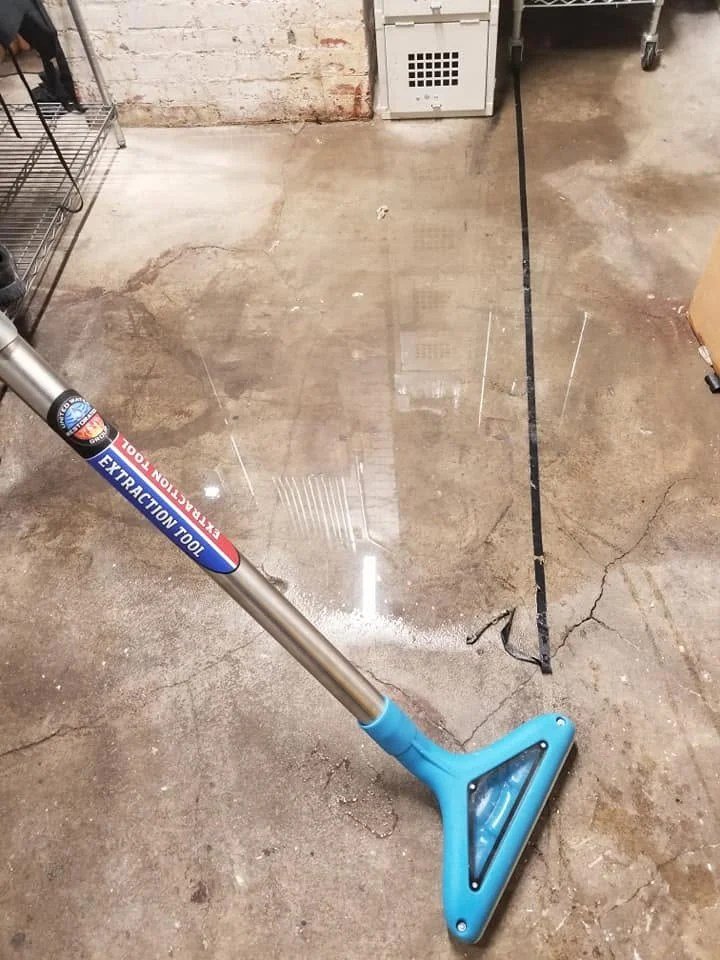
- 4Bulk water removal. Submersible pumps for anything deep enough to pump, then truck-mount or portable extraction, then weighted extraction on carpet — which presses carpet and pad against the tool while drawing vacuum.
- 5Equipment set. Air movers and dehumidifiers placed for the class of loss and the conditions in the space.
Extraction is not drying. It removes free water — what you can see and reach. What is left is bound into the materials and comes out over the following days through structural drying.
Water damage
What kinds of emergency do you get called to most?
Five patterns account for the overwhelming majority, and each has a different local season.
Burst and frozen pipes — December to February. Burst risk climbs sharply below about 20°F with six or more hours of exposure, concentrating in unheated crawl spaces, garages, north-facing exterior walls, and homes sitting empty with the heat set low. The Front Range crossing 32°F several times in a single day is what drives it, and Colorado Springs Utilities attributes elevated water main break rates to that same freeze-thaw cycle.
Appliance and supply line failures — year round. Washer hoses, fridge lines, dishwashers, water heaters. The most common loss in any market including this one, and the one most likely to happen while nobody is home.
Basement seepage — after irrigation and during the monsoon. Expansive bentonite clay swells and presses water through the cove joint where the floor slab meets the wall. Water appears along the perimeter of the floor with no leak anywhere upstream.
Sewer and septic backup — during monsoon storms. Municipal surcharge when stormwater infiltrates the sanitary system, root-intruded clay laterals in the older Westside, and septic failure in Black Forest and Falcon.
Storm and burn-scar flooding — mid-July to mid-September. Flooding off the Waldo Canyon scar can begin within about 15 minutes of heavy rain starting, on rainfall totals that would do nothing in an unburned watershed.
Colorado Springs
What can I do while I wait for the crew?
Four things that genuinely reduce the final scope, and two that make it worse.
Worth doing:
Get air moving, but do it correctly. Point a box fan or a floor fan across the wet area at a low angle rather than straight down at it. Angled airflow sweeps the saturated layer of air off the surface and lets evaporation continue; air aimed straight down just pressurises one spot. If it is warm and dry outside, open windows. If it is humid or raining, keep them shut and run whatever dehumidification you have with the doors closed.
Get things up off the floor. Furniture legs stain carpet — wooden legs bleed and metal glides rust, and both marks are permanent. Slide foil, plastic lids or blocks under the legs. Cardboard boxes wick water upward and collapse, so move those first. Lift rather than drag.
Open what you safely can. Cabinet doors, vanity kickboards and closet doors under and beside the affected area. Enclosed cavities are where water sits longest and where growth starts first, and simply opening them buys hours.
Pull up small rugs and lift what is loose. Anything absorbent that is not attached comes out of the water now.
Not worth doing, or actively harmful:
Do not use a household vacuum. A dry vacuum on water is an electrocution risk, and even a shop vac will not pull water back out of carpet pad or drywall. It moves the visible water and leaves the problem.
Do not turn the heat up high. It feels intuitive and it is the wrong move without dehumidification present. Warm air holds far more moisture, and driving evaporation with nowhere for the moisture to go pushes it into cooler assemblies and cold exterior walls, where it condenses. In a Colorado Springs winter that means moving your problem from a warm basement into a cold north-facing wall cavity.
Water damage
What if I rent, or this is a rental property?
Call the landlord or property manager first, then call us — but do not let the first call delay the second one by more than a few minutes.
Who typically pays for what: the building owner insures the structure, and the tenant’s renters policy covers the tenant’s own belongings. Renters insurance does not repair the building, and the landlord’s policy does not replace your furniture. Both parties usually need to file.
What tenants should do: photograph everything before moving anything, report it to the landlord in writing — text or email, so there is a timestamp — and keep the receipt for anything you buy to limit the damage.
What owners and managers should do: authorise mitigation immediately. Most policies place a duty on you to prevent further damage, and the cost of waiting overnight for a decision routinely exceeds the cost of the first night’s equipment.
In multi-family buildings, water crossing between units becomes two claims fast. Containment placed early is what keeps one incident from becoming three, and everyone involved works better from a shared moisture log than from three different memories of what happened.
Colorado Springs
What if the loss is in a vacant or seasonal property?
This is more common here than most markets, and it produces the worst losses on the board.
Colorado Springs has heavy PCS turnover around Fort Carson, Peterson Space Force Base and Schriever, plenty of second homes, and a steady supply of listed-but-empty houses. A supply line that fails in an occupied house is a bucket. In an empty house it is a week of running water.
Winter is when it happens. Burst risk climbs sharply below about 20°F with six or more hours of exposure, and empty properties concentrate every risk factor at once — heat set low or off, no one to hear it, and often an unheated crawl space or garage in the run.
If you own or manage an empty property here: keep the heat at 55°F or above rather than off, shut off the water at the main and drain the lines if it will be empty through a cold stretch, open cabinet doors under sinks on exterior walls, and have someone physically walk it weekly. Insurers also frequently limit or exclude coverage for freeze losses in vacant dwellings where reasonable heat was not maintained or the water was not shut off — which turns a large claim into a large bill.
Water damage
Do you come out at night, at weekends, on holidays?
Yes. Water does not keep business hours and neither does the damage.
Two things worth knowing about after-hours calls in this market:
Ask whether there is an emergency surcharge. Practices vary and there is nothing wrong with either answer — but you should know before someone is standing in your hallway at midnight, not after.
After a regional storm event, everyone is stretched. When a significant hail cell or a monsoon flood hits, carriers surge adjusters in, contractors run at capacity, and out-of-area firms arrive. If we cannot get to you faster than someone else can, we will say so. A crew arriving in ninety minutes is worth more to you than a promise from a crew arriving in four hours.
Colorado Springs
Do you cover my part of Colorado Springs?
Colorado Springs and El Paso County.
Reached quickly: downtown and Shooks Run (80903), Old North End (80907), Westside and Old Colorado City (80904, 80905), Broadmoor and Skyway (80902, 80906), the southeast (80910, 80916), east Colorado Springs (80909, 80915, 80917), Austin Bluffs and Vista Grande (80918), Rockrimmon and Mountain Shadows (80919), Briargate and Northgate (80920, 80921), and the Powers corridor through Stetson Hills and Wolf Ranch (80922, 80923, 80924, 80938, 80939, 80951).
Genuinely longer drive: Peterson Space Force Base (80914), Fort Carson, Security-Widefield and Fountain (80911, 80913, 80925, 80926), Black Forest and Falcon (80908), and Banning Lewis Ranch and the far east (80927, 80928, 80929, 80930). We will give you a real time on the phone rather than a hopeful one.
Water damage
Is this actually an emergency, or can it wait until morning?
An honest test, because not everything needs a 2 a.m. call-out.
Call now if any of these are true:
- Water is still coming in
- It is near the electrical panel, the furnace or the water heater
- It came from a sewer line, a septic system or from outdoors
- It has reached a finished basement, carpet or drywall
- There is more than a small, containable amount
- Anyone in the house has a respiratory condition and there is any smell
It can probably wait until morning if all of these are true:
- Clean supply water, source already stopped
- Under roughly 10 square feet
- On a hard surface, or on carpet you can lift tonight
- Nothing near electrical
- You can get the pad up and a fan on it now
If it can wait, lift the carpet, pull the pad, put a fan across it at a low angle and a dehumidifier in the room with the door shut. Then call in the morning if it still feels damp or a smell develops.
A shop vac will not get water out of carpet pad, pull it back out of drywall, or tell you whether the subfloor underneath is still wet. Those three things are what decide whether a small job stays small.
Colorado Springs
What happens when you call
- 1Three or four questions. Where the water came from, how long it has been there, what it has reached, whether it is still coming in.
- 2A time, not a window.
- 3Extraction starts on the first visit, then we meter. Scope and quote come from readings.
Call (719) 618-9013 — Colorado Springs and El Paso County, 24 hours a day.
📞 Call (719) 618-9013Frequently asked
Questions people actually ask
How fast can you actually get here?
Do you charge extra for nights and weekends?
Should I turn the power off?
Can I start cleaning up before you arrive?
What if the water is still coming in?
Will you take the carpet out?
Call Dry Standard Restoration
IICRC-certified. We meter before we quote, and you get the readings.
24/7 — Colorado Springs and El Paso County