How to Document Water Damage for Your Insurance Claim
Photograph everything before you move anything, get a picture of the actual failure before it is repaired, and keep the moisture readings. Those three things carry more weight in a water claim than anything you will say to an adjuster.
- ✓IICRC-certified technicians
- ✓Documentation in the format adjusters expect
- ✓Colorado Springs and El Paso County
Water damage
Why does documentation decide water claims specifically?
Because water damage is the category where the facts are hardest to establish after the event.
Compare it to hail. A hail claim is corroborated by weather data — either a storm crossed your neighbourhood on a given date or it did not. There is very little to argue about.
Water leaves no external record of when it started. A leak inside a wall cavity announces itself only through the condition of the materials, and those materials get removed during mitigation. The evidence is destroyed by the process of fixing the problem — which is exactly why it has to be captured first.
This matters more than it might seem. Water damage and freezing is the second most common home insurance claim category in the United States, at roughly 24% of all claims, and it carries the highest denial rate of any category at around 10% — with the reason recorded almost always being that the damage was judged gradual rather than sudden.
Documentation is what turns that from an argument into a demonstration.
Colorado Springs
The first ten minutes: what to capture before anything moves
The most valuable documentation happens before anyone has thought about a claim at all.
Photograph in this order, and do not tidy first:
- 1Wide shots of each affected room from two corners, showing the whole space and how the water spread.
- 2The water itself — standing water, the extent of it, where it reaches on walls and furniture.
- 3Close-ups of damaged materials — the waterline on drywall, buckled flooring, wet carpet, stained ceiling.
- 4Contents in place, before they are lifted. Furniture legs in water, boxes sitting in it, what is on the floor.
- 5Anything with a serial number or a label that may need replacing.
- 6The source, if you can see it safely.
Then video. A slow walkthrough with the camera steady, narrating what you are seeing and saying the date aloud. Timestamped video with narration is harder to dispute than stills and takes ninety seconds.
Then move things. Getting contents out of standing water is worth doing quickly — but ninety seconds of photography first protects the claim, and it is time you will not get back.
Call (719) 618-9013 as soon as you have those photographs. Extraction should start in hours, not days.
📞 Call (719) 618-9013Water damage
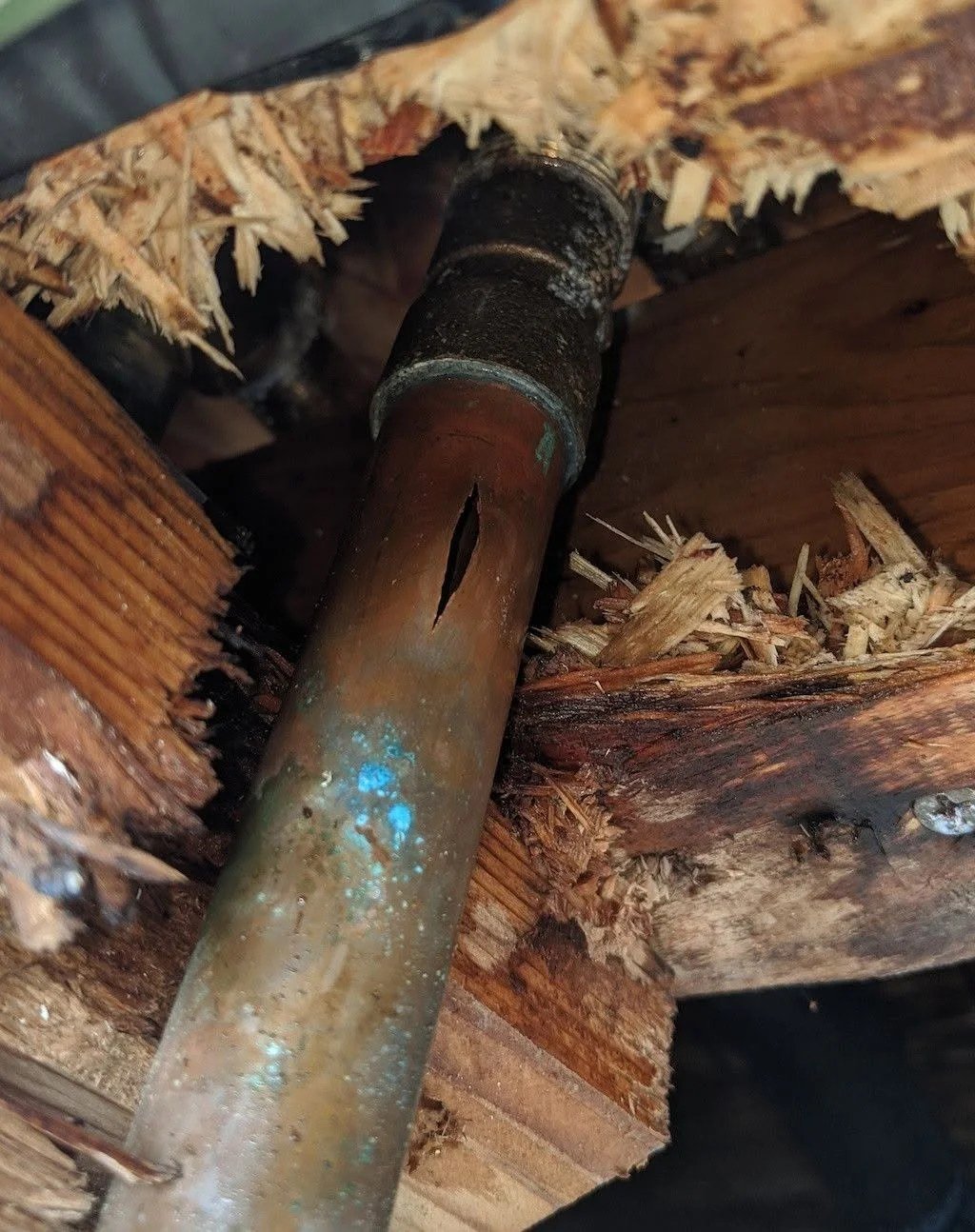
The single most valuable photograph you will take
A picture of the actual failure, before it is repaired.
The split in the pipe. The corroded fitting. The burst supply hose. The cracked shower pan. The failed water heater tank.
It is the image most often lost, because the sequence goes like this: water appears, you call a plumber, the plumber fixes the pipe and takes the failed section away, and by the time anyone thinks about the claim the physical evidence of a sudden failure is in the back of a van.
What to do:
- Photograph the failure point before the plumber touches it, if you safely can.
- Ask the plumber to keep the removed section. Most will, if asked. Put it in a bag.
- If they have already gone, ask for a photograph — many take them routinely.
- Get the plumber’s invoice with the date and a description of what failed.
Why it matters so much: a clean break in a pipe wall is evidence of a sudden event. Heavy corrosion and mineral scale around the failure is evidence of a long-developing one. That distinction decides claims, and an adjuster arriving three days later can only assess what is left in front of them.
Colorado Springs
Moisture readings: the documentation most people never get
Photographs show what is visible. Moisture readings show what is not, and they are the part of the record adjusters find hardest to argue with.
A proper moisture log records readings taken on affected material and compared against unaffected material of the same type in the same building — the baseline. That comparison is what makes a number meaningful. A reading of 18% means nothing on its own; 18% against a 9% baseline on the same material means a great deal.
What the log should contain:
- Date and time of each reading
- Location, specific enough to find again
- Material type
- The reading, and the baseline for that material
- Meter type — pin or pinless
- Ambient temperature and relative humidity in the space
- Equipment in place and where
Ask your restoration contractor for a copy. Any competent company produces this as part of the drying process; not all of them hand it over unless asked. It should arrive as a document, not as a verbal assurance that things were checked.
Why this matters more in Colorado Springs than most places
Dry air pulls moisture off exposed surfaces fast. Drywall faces, carpet and subfloor tops feel dry within a day or two while the assembly behind them is still holding water. There is no condensation and often no smell, because the moisture is not reaching the room.
So an inspection based on touch will understate how much material is wet — and the estimate follows the inspection. A documented reading against a same-material baseline is not an opinion, and it is very hard to scope around.
Water on the floor right now?
Tell us where it came from and how long it has been there. We will give you a time, not a window.
24/7 — Colorado Springs and El Paso County
Water damage
What to write down while it is still fresh
Memory degrades and claims take months. Write these down on day one.
- When you first noticed anything at all. Not when the damage appeared — when you first noticed a smell, a sound, a mark, a change in the floor. Be honest, including if it was a while ago.
- What you did and when. Times, not “that afternoon.”
- Who you called and when. Carrier, plumber, restoration company, with names and times.
- Your claim number and the name of every person you have spoken to.
- Anything anyone told you verbally, with the date and who said it.
That last one matters more here than most people expect. The most common complaint in the local review corpus is not about scope or price — it is about verbal assurances that were not honoured:
"We hired [company] after their representative assured us multiple times that the work would be covered by our insurance. We relied on that information in good faith. Only after the work was completed did we learn that none of…"
📞 Call (719) 618-9013Write down who said what and when. Then get anything important confirmed by email.
Colorado Springs
The contents inventory
The part everyone underestimates, and the part that pays.
For each damaged item, record: what it is, make and model where relevant, approximate age, approximate original cost, and a photograph. Group similar low-value items rather than listing socks individually.
Practical points:
- Do not throw anything away before it is photographed, including things you are certain are ruined.
- Keep a sample of removed material where practical — a piece of the carpet, a section of the flooring. It helps establish grade and quality when a replacement figure is being argued.
- Receipts and card statements are strong evidence for higher-value items. Bank apps go back years and are searchable.
- Photographs from before the loss are gold if you have them. Old family photos and phone pictures often show a room incidentally, which establishes what was there and its condition.
- Note whether contents settle at actual cash value or replacement cost. Your policy determines this and it changes what documentation is worth gathering.
A note for basements specifically: if you are claiming under a flood policy rather than homeowners, contents in a basement are treated very differently — there is generally no contents coverage below grade under NFIP terms regardless of flood zone. Check which policy is responding before spending a weekend on an inventory.
Water damage
Documenting the mitigation itself
The work done to your house is part of the record, and it supports both the mitigation invoice and any later supplement.
Keep:
- The scope of work, in writing, before work starts
- Daily moisture readings for the duration of drying
- Equipment logs — what was placed, where, and for how many days
- Photographs at each stage — before, during demolition, and once the structure is open
- Photographs of what came out, before it leaves the property
- The mitigation invoice, itemised
Photographs taken once material is removed are frequently the most useful of all, because they show what was behind the wall — the wet insulation, the stained framing, the failure point, the extent of the growth. That is the evidence the adjuster could not see on their visit, and it is the foundation of most successful supplements.
Colorado Springs
What documentation actually protects you from
Four specific arguments, and knowing which is which helps you know what to capture.
| The argument | What defeats it |
|---|---|
| “This was gradual, not sudden.” | The failure-point photograph, the plumber’s invoice with date, day-one moisture readings, and the absence of old staining in your wide shots |
| “The damage was smaller than that.” | Moisture readings mapping the wet area, and photographs taken once material came out |
| “You should have caught this sooner.” | A written note of when you first noticed anything, plus the fact that surfaces here feel dry while assemblies stay wet |
| “You made it worse by delaying.” | Your timeline of calls, and the mitigation start time |
Most policies also place a duty on you to prevent further damage after a loss. Documenting that you acted promptly is what demonstrates you met it — and waiting several days for an adjuster while the water sits works against you rather than for you.
Water damage
How to organise and send it
Adjusters handle many files at once, particularly after a storm event. Make yours easy.
- One folder, dated subfolders.
2026-08-01 initial/2026-08-03 demolition/2026-08-06 readings. - Descriptive filenames rather than IMG_4471.
- A one-page summary at the front: what happened, when, what has been done, what is outstanding.
- Send by email, so there is a record and a timestamp. Use a file-sharing link for large sets rather than twelve separate messages.
- Include your claim number in every subject line.
- Keep your own copy of everything you send.
A well-organised file changes how a claim is handled. It is not about being difficult; it is about being easy to say yes to.
Colorado Springs
If your claim has already been denied
Documentation is also what reopens a claim, and denials are reversed more often than people assume.
- 1Get the denial in writing with the specific policy language quoted.
- 2Match your evidence to the stated reason. A gradual-damage denial is answered with the failure-point photograph, the dated plumber's invoice and the day-one readings — not with a general protest.
- 3Request a re-inspection and supply the file.
- 4Escalate to a supervisor if that goes nowhere.
- 5File a complaint with the Colorado Division of Insurance. Free, and it creates a record.
- 6Then consider counsel. Colorado provides a statutory remedy for unreasonable delay or denial of first-party benefits under C.R.S. §§ 10-3-1115 and 10-3-1116, allowing recovery of two times the covered benefit plus reasonable attorney fees and costs.
Water damage
What happens when you call
- 1We photograph and meter from the first visit, before anything is moved or removed.
- 2You get the moisture log and the photographic record, as documents, whether or not we do the reconstruction.
- 3We will speak to your adjuster directly if you want us to.
Call (719) 618-9013 — Colorado Springs and El Paso County, 24/7.
📞 Call (719) 618-9013Frequently asked
Questions people actually ask
Should I wait for the adjuster before cleaning up?
How many photos is enough?
What if I already moved things before taking photos?
Do I need professional documentation, or is my phone enough?
How long should I keep all this?
Will documenting make me look like I am building a case?
Call Dry Standard Restoration
IICRC-certified. We meter before we quote, and you get the readings.
24/7 — Colorado Springs and El Paso County