Black Mold in Colorado Springs — What It Is and What It Isn't
Colour does not determine risk, and it does not change the remediation. Any mold on a porous surface gets removed the same way, whatever shade it is.
- ✓IICRC-certified technicians
- ✓Work to the IICRC S520 standard
- ✓Colorado Springs and El Paso County
Water damage
What is black mold, actually?
“Black mold” is a common name, not a scientific one. It usually refers to Stachybotrys chartarum — a dark, often slimy-looking mold that grows on very wet cellulose material: soaked drywall, saturated cardboard, wet wood, waterlogged paper.
The important part is what its presence tells you. Stachybotrys needs sustained, heavy moisture. It does not colonise something that got damp last Tuesday. If it is genuinely present, water has been sitting somewhere for weeks, and the moisture problem is bigger than the patch you are looking at.
But most dark growth is not Stachybotrys. Cladosporium and Alternaria are extremely common indoors, both frequently dark green to black, and both far more likely to be what is on your bathroom ceiling or window frame. You cannot tell the difference by eye. Neither can anyone else, including the person quoting you.
Colorado Springs
Is black mold more dangerous than other mold?
The honest answer is that this is genuinely contested, and the certainty you will find on a lot of restoration websites is not supported.
What is well established: mold exposure can cause allergic reactions, asthma symptoms, and respiratory irritation, and those effects are worse for people with asthma, existing allergies, or compromised immune systems. That is true of mold generally, not of one species.
What is not established: the widely repeated claims linking Stachybotrys specifically to severe systemic illness in otherwise healthy people. That idea entered public consciousness in the 1990s and the science behind it has been substantially walked back since.
There is also no federal or Colorado standard for acceptable indoor mold levels, so nobody can tell you that you have crossed a threshold. There is no threshold.
What this means practically: if anyone in your house is symptomatic, that is a conversation with a physician, not with a restoration contractor. And if a company leads its pitch with what black mold will do to your family’s health, that tells you more about the company than about the mold.
Water damage
Why do so many companies lead with "black mold"?
Because fear converts, and the phrase has been doing marketing work for thirty years.
It is worth naming plainly, because it is common in this market. Two things to watch for:
- A species identification made by eye. Nobody can identify Stachybotrys visually. A technician who says “that’s black mold” while standing in your basement is guessing, and usually guessing in the direction of a larger invoice.
- A price that changes with the colour. The protocol does not change by species. If a quote goes up because a patch looks black rather than green, ask what specifically in the scope of work is different. There should be a concrete answer, and usually there is not.
Colorado makes this easier to exploit than most states. There is no state licensing or registration for mold remediators, and CDPHE does not regulate mold. A 2025 bill that would have created a registration system did not pass. Anyone can print “certified mold specialist” on a van.
Water on the floor right now?
Tell us where it came from and how long it has been there. We will give you a time, not a window.
24/7 — Colorado Springs and El Paso County
Colorado Springs
How is black mold removed?
The same way any mold is removed, because the protocol is set by the material and the extent, not by the species.
- 1Find and fix the moisture source. Nothing else matters if this is skipped. Growth that reaches Stachybotrys territory means sustained saturation, so the source is usually something ongoing — a slow supply leak, a failed shower pan, an absent vapour barrier in a crawl space, or cove joint seepage that recurs every irrigation cycle.
- 2Containment. Sealed plastic, work area under negative pressure through HEPA filtration, so demolition does not distribute spores through the house.
- 3Remove porous material. Drywall, insulation, carpet pad, ceiling tile. Growth on drywall is inside the paper facing, not on the surface — it cannot be cleaned off.
- 4Clean what remains. HEPA vacuum, damp wipe, then antimicrobial. Framing lumber is almost always saveable.
- 5Dry to a documented dry standard and verify.
That is the IICRC S520 sequence, and it is identical whether the growth is black, green, white or grey.
Water damage
Why does mold get found late in Colorado Springs?
Because dry air hides wet buildings, and this is the local mechanism that matters most on this page.
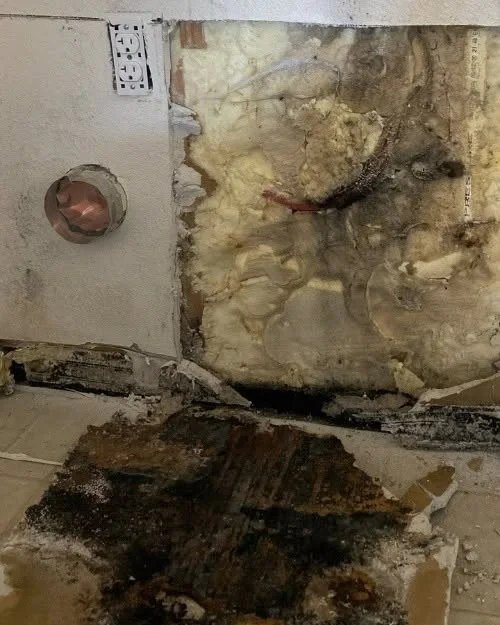
Low ambient humidity means moisture evaporates readily from exposed surfaces. Drywall faces feel dry. Carpet feels dry. The room smells normal. Behind the drywall and under the pad, the assembly is still holding water — and because the surface is dry, there is nothing drawing that moisture out and nothing to give it away.
No condensation. No musty smell in the room, because the moisture is not reaching the room. Nothing visible for weeks.
By the time growth appears or an odour develops, the moisture has usually been there long enough for heavy colonisation — which is exactly the condition Stachybotrys needs. The dry climate here is a large part of why “black mold” gets found in Colorado Springs basements at all.
Three local patterns where we see it:
- Crawl spaces after the monsoon — water gets under the house in late July, nobody looks until autumn
- Delayed dry-out after burn-scar flooding below the Waldo Canyon and Black Forest scars
- Empty homes during PCS season, May through August, with a slow leak and nobody in the building
Colorado Springs
Should I get it tested?
Usually not, if you can see it and you know where the water came from. Testing tells you the species. The species does not change the protocol, so for most homeowners it is several hundred dollars and a week’s delay to confirm what you are going to do anyway.
Testing earns its cost when:
- You can smell it but cannot find it — air sampling against an outdoor control helps narrow where to open up
- A purchase, sale or dispute depends on documentation
- Someone is symptomatic and a physician has asked for it
- You want independent post-remediation verification — which is the one situation where testing is genuinely worth paying for
Water damage
Can I clean it myself?
Sometimes. If all of these are true:
- Under roughly 10 square feet
- On a hard, non-porous surface — tile, glass, sealed concrete, finished metal
- You know the moisture source and it has been fixed
- Nobody in the house has asthma, a mold allergy, or is immunocompromised
Gloves, an N95, ventilate the space, clean with detergent and water rather than bleach, dry thoroughly and keep it dry.
Bleach is the common mistake. On porous material it does not penetrate — it removes the colour and leaves the growth. That is why people believe mold “keeps coming back” after they cleaned it. It never left; it just stopped being black.
Stop and call if: it is on drywall, wood or any porous surface · it covers more than about 10 square feet · you cannot identify the moisture source · it has returned after cleaning · anyone in the house has a respiratory condition.
Colorado Springs
What happens when you call
- 1You describe it — where, how big, what the surface is, how long, and whether anything has been wet.
- 2We tell you whether it needs us. A patch of Cladosporium on a bathroom ceiling with a working extractor fan does not.
- 3If it does, we inspect and meter before quoting. You get readings and a written scope, not a species diagnosis made by eye.
Call (719) 618-9013 — Colorado Springs and El Paso County.
📞 Call (719) 618-9013Frequently asked
Questions people actually ask
How can I tell if it is really black mold?
Does black mold have a distinctive smell?
Is it safe to sleep in a house with black mold?
Why does it keep coming back after I clean it?
Does insurance cover black mold?
Call Dry Standard Restoration
IICRC-certified. We meter before we quote, and you get the readings.
24/7 — Colorado Springs and El Paso County